
An update from the Short Duration Grazing treatment at the Wambiana Grazing Trial
In September 2024 , the DPI introduced a new treatment at the long-running Wambiana Grazing Trial to test a question of considerable interest to graziers: can more intensive, short-duration grazing management help accelerate the recovery of land in poor condition relative to simply locking paddocks up?
The treatment, now known as Short Duration Grazing (SDG), replaced the two heavy stocking-rate paddocks that had been grazed at around 4–5 hectares per adult equivalent for the previous 26 years. By 2022, these paddocks, were in poor condition, with relatively few desirable perennial grasses present. Following destocking at the end of the very dry 2021-22 season and a subsequent very wet season, the new SDG treatment commenced in April 2024.
The concept behind SDG is relatively simple. Rather than leaving cattle in a paddock for long periods, a large mob is used for a short grazing period, with the time in the paddock determined using a forage budget. The paddock is then given an extended rest to allow pasture recovery. The treatment is being managed with advice from experienced multi paddock grazing practitioners Fran Lyons and Jamie Gordon.
Two years of grazing
Since the treatment began, the two SDG paddocks, 92 ha and 103 ha respectively, have been grazed six times, with grazing periods ranging from about two to five days. The first two grazes occurred in April and July 2024, with large mobs of 443 and 500 AE (animal equivalents) respectively, loaned from the Lyons family of Wambiana. The paddocks were only lightly to moderately grazed, with the key 3P (palatable, perennial, productive) grasses receiving relatively light defoliation. The paddocks were then rested for the remainder of the season.
The following wet season demonstrated one of the practical challenges of this type of management—adapting management to seasonal conditions. The planned early-season graze in 2024-25 was delayed due to an uncertain start to the wet season and then more than 300 mm of rain from the February monsoon event was received. Flooding of the Campaspe River temporarily stranded cattle on the opposite side of the river delaying the graze even further. When conditions finally allowed access, a forage budget was undertaken with the producer advisors and the paddocks grazed in late March 2025.
The March 2025 graze involved 296 heifers and calves (539 AEs), with the two paddocks grazed for 1.8 and 3.6 days respectively. Conditions were rainy and soils moist, but the cattle were removed promptly after a heavy overnight fall, avoiding significant trampling damage. The paddocks were then spelled before a second graze later in the year.
A second 2024/25-season graze occurred in late September 2025, when 712 heifers (562 AEs) were used. Again, the paddocks were assessed as moderately grazed, retaining good groundcover and residual pasture mass going into the following wet season.
The 2025-26 season
The plan for 2025-26 was to graze relatively early in the wet season. However, exceptionally wet conditions in January and February 2026 made this impossible. Flooding restricted access to the cattle and, more importantly, putting a large mob onto saturated country would have risked substantial trampling and soil damage.
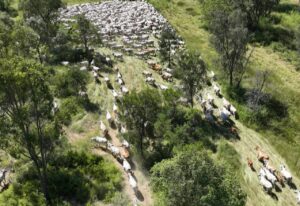
The first graze was therefore delayed until late March. A large mob of 637 heifers and young calves (880 AEs) was used, with the grazing period of 2 to 3 days depending on the paddock, again based on a forage budget determined with advice from the producer advisors. Subsequent pasture observations showed that paddocks had been moderately utilised, leaving adequate forage for another graze.
A second graze of 3 days followed in early July 2026, with 591 heifers and 42 young calves (697 AEs). Once again, the pasture utilisation was assessed as moderate. A third graze may be undertaken later in the dry season, depending on seasonal conditions and available pasture.
So, is it working?
This is where the results become particularly interesting—and where some patience is required.
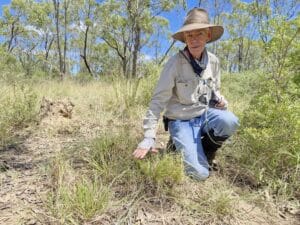
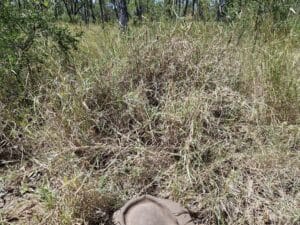
There was a substantial increase in total pasture yield and 3P grass yield between the end of the former heavy stocking treatment in 2022 and the first SDG measurements in 2024. However, similar improvements also occurred in the other trial treatments, suggesting that much of this initial response was probably due to the very favourable rainfall rather than SDG treatment alone. The legacy of 26 years of heavy stocking in the SDG paddocks also means that recovery from the starting condition was never expected to be immediate.
The grazing exclosures established within the SDG paddocks will provide another useful benchmark. These areas have been completely protected from grazing and will allow pasture recovery under no grazing to be compared with recovery under SDG.
Importantly, the results to date have shown that recovery can occur, and some production can be maintained without completely excluding grazing, with the SDG yielding from 26 to 50 stock days (SD) per ha annually over the last three years.
These results are still very much a work in progress and it is too early to conclude that SDG is accelerating land-condition recovery. The important question is whether differences between SDG, complete spelling and the other Wambiana grazing strategies will become clearer over the coming years.
What happens next?
The SDG treatment will continue to be monitored alongside the other long-term Wambiana treatments through to the end of the current project in 2029. The emphasis will remain on measuring pasture composition, pasture yield, groundcover, and stock grazing days, while also documenting and learning about the practical requirements of managing large mobs for short periods.
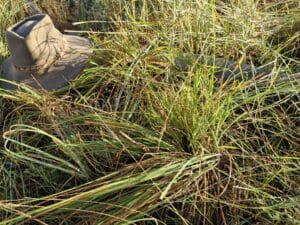
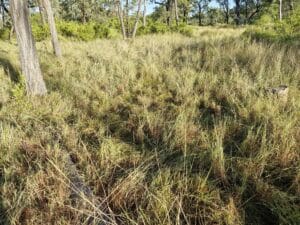
One of the most important lessons already emerging is that SDG is not simply about putting more cattle into a paddock for a short time. The timing, duration and intensity of each graze have to be matched to the amount of forage available and the condition of the country. The unusually wet seasons experienced since the treatment began have provided several real-world examples of why flexibility is essential.
After more than three years, the experiment has not yet produced a simple answer as to whether intensive short-duration grazing can fast-track recovery of degraded country. But that is precisely why the treatment is being conducted at the trial. By continuing to measure what happens under SDG—and comparing it with both conventional grazing strategies and complete spelling—we will have scientific data to formulate a much clearer answer by the end of the trial.
For now, the paddocks are being managed cautiously with the guidance of our producer advisors, with the objective of maintaining and improving groundcover, protecting recovering perennial grasses and allowing time for the legacy of 26 years of heavy stocking to be overcome.
The Wambiana grazing trial is part of the Improving Grazing Land Management Project. We thank the Lyons family of Wambiana for the loan of their cattle for the SDG grazes.
Written by John Bushell and Peter O’Reagain and from Charters Towers DPI, as part of the Queensland Pasture Resilience Program which is a partnership between the Department of Primary Industries, Meat & Livestock Australia and the Australian Government through the MLA Donor Company.
