Why are we doing this work?
Pasture legumes have long been recognised as a potential tool to improve pasture quality, livestock performance and pasture resilience across northern Australia. However, adoption has been limited by uncertainty around suitable species, establishment and production benefits under commercial grazing conditions on an extensive scale. These questions, coupled with uncertainty around Government approvals has resulted in essentially no dryland pasture improvement over the last 25 years in northern Western Australia (WA).
The Legume Establishment project was developed to address these knowledge gaps through producer-led demonstrations across the Northern Territory (NT) and WA.
The project originated from the University of New England-led Future Drought Fund project Legumes in Tropical Pastures for Climate Resilience – Overcoming the Knowledge Gaps and has since expanded through collaboration between the Northern Territory Department of Agriculture and Fisheries, the Department of Primary Industries and Regional Development (DPIRD) in WA, the Northern Hub and pastoral industry partners.
Most research on tropical pasture legumes has been conducted in Queensland. However, production systems, soils, climate and management practices differ substantially between Queensland, the NT and northern WA. As a result, uncertainty remains around the establishment, persistence, productivity and economic performance of legumes under northern pastoral conditions.
Demonstration sites
Demonstration sites have been established across northern Australia in partnership with pastoral producers.
Sites currently include:
• Northern Territory – Victoria River Research Station (Kidman Springs), Mount Sanford, Pigeon Hole, and Victoria River Downs.
• Western Australia – Alice Downs, Country Downs, Dampier Downs, Diggers Rest, Jubilee Downs, Larrawa, Mabel Downs, Spring Creek and Springvale stations in the Kimberely and Limestone station in the Pilbara.
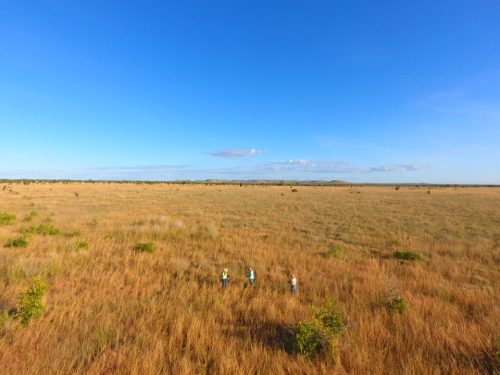
Together these sites represent a broad range of soil types, rainfall zones and grazing environments, providing an opportunity to assess legume performance under diverse commercial conditions.
The focus in the NT is on legume options for black cracking clay soils, while in northern WA identifying the potential for growing stylos. The NT results are applicable for similar soils and environments in northern WA and likewise the WA results for the NT.
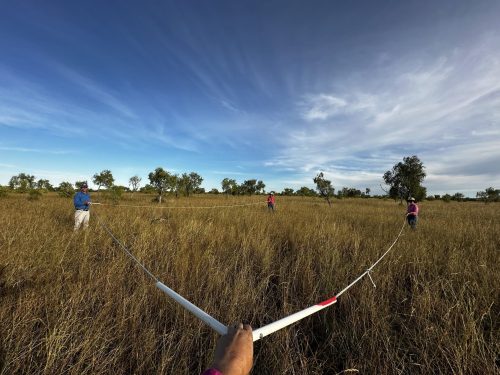
Monitoring is undertaken using standardised methods developed jointly by NT and WA project teams and includes monitoring establishment, persistence and cattle production demonstrations.

(i) Northern Territory – Legume options for cracking clay soils
Key messages
• Legume establishment on cracking clay soils remains challenging and highly dependent on seasonal conditions.
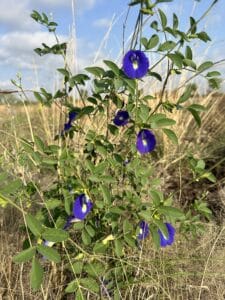
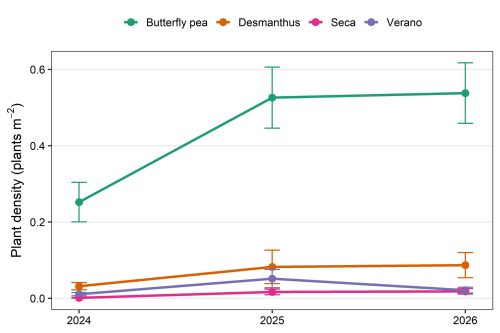
• Butterfly Pea consistently outperformed all other legume species and remains the most promising option evaluated.
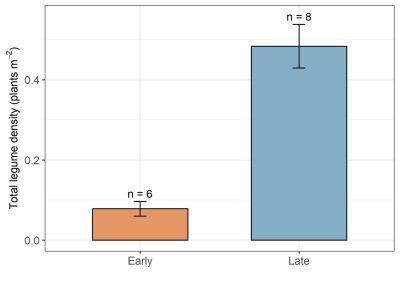
• Sowing close to the monsoonal onset (usually early January) and reducing pasture competition generally improved establishment.
• Establishment success varied substantially between sites and within sites, highlighting the importance of local conditions and landscape position.
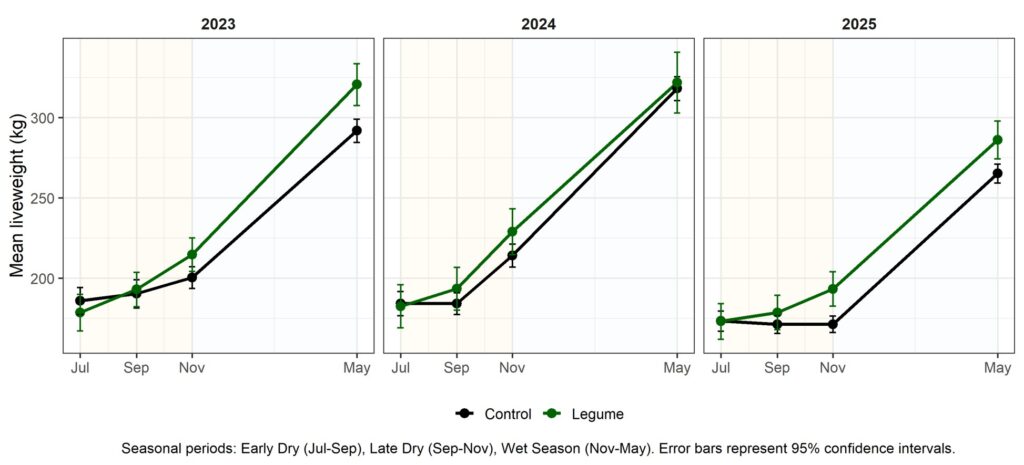
• Established legume pastures improved weaner growth, particularly during the dry season when native pasture quality declines.
• The legume density required to deliver meaningful improvements in performance in the Victoria River District (VRD) remains uncertain and is being investigated through a grazing demonstration on Mt Sanford.
What are we investigating?
The NT component is focused on three key questions:
• Which pasture legume species establish most reliably under northern grazing conditions?
• Which management practices improve long-term persistence?
• Do established legume populations improve cattle production?
What did we do?
This project was designed to address several knowledge gaps identified by northern beef producers regarding pasture legumes. Rather than testing a single research question, the project used a series of demonstrations and monitoring activities to investigate practical questions about legume establishment and productivity.
Three main activities:
• Kidman Springs establishment demonstrations investigated which legume species are best suited to cracking clay soils and how establishment can be improved through different management practices. Small plot trials compared Butterfly pea (Clitoria ternatea), Progardes® Desmanthus, Seca stylo (Stylosanthes scabra) and Verano stylo (Stylosanthes hamata) under different seedbed preparations, sowing times and sowing rates.
• Commercial-scale demonstrations were established on Heytesbury Pastoral Company properties, including Mt Sanford, to test legume establishment under commercial conditions and increase producer involvement in the project. These demonstrations compared species performance and establishment methods at a scale relevant to pastoral enterprises.
• A grazing demonstration at Kidman Springs compared liveweight gain of weaner cattle grazing native pastures with established stylos against cattle grazing native pasture alone. This provided benchmark information on the potential production benefits of legumes in the VRD.
What have we found so far?
Establishing legumes on cracking clay soils remains challenging
The small plot demonstrations provided valuable information on species performance and establishment methods. However, establishment was generally lower than expected, highlighting how strongly establishment success is influenced by seasonal conditions and the timing of rainfall relative to sowing and seedbed preparation.
Butterfly Pea was the most reliable species
Across Kidman Springs and Mt Sanford, Butterfly Pea consistently achieved higher plant densities than the other legumes evaluated. Desmanthus and the stylo cultivars established less reliably and generally remained at lower densities. Butterfly Pea continues to demonstrate the greatest potential for cracking clay soils in the VRD.
Management can improve establishment
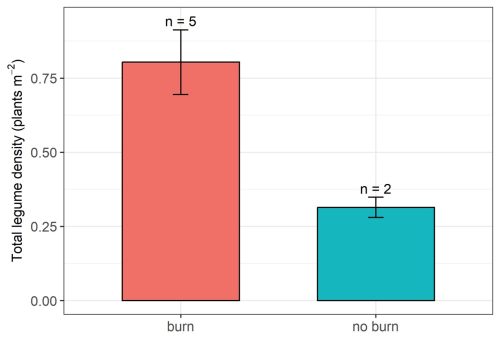
Higher plant densities were generally associated with January sowing and reduced pasture competition through burning. However, responses varied considerably between years and sites, reinforcing the importance of seasonal conditions and local environmental factors.
Site selection matters
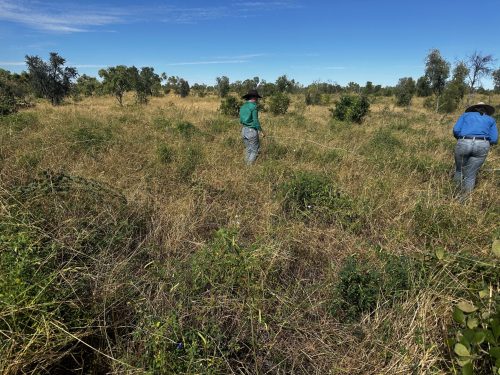
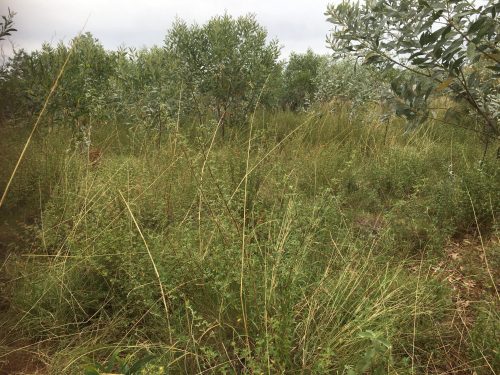
Field observations within the larger commercial-scale demonstration at Mt Sanford suggested that establishment success was not solely determined by treatment effects. The strongest establishment was observed on alluvial flats and in areas adjacent to drainage lines, indicating that factors such as soil moisture, fertility and landscape position may have contributed to improved establishment. Large butterfly pea plants were also commonly observed climbing through rosewood shrubs across the site. The shrubs appeared to provide structural support for vine growth, allowing plants to extend above the surrounding pasture canopy and potentially access more light, resulting in greater plant size and biomass production. Together, these observations highlight the importance of considering both site selection and the existing vegetation when planning legume establishment programs.
Legumes improved weaner performance
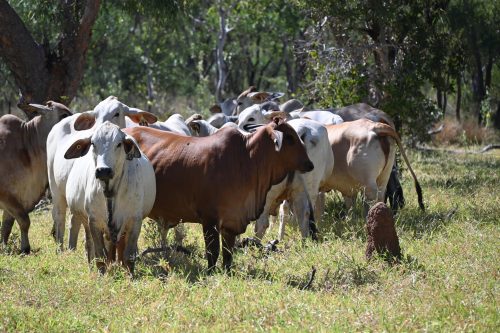
The Kidman Springs grazing demonstration showed that cattle grazing stylo-native pasture maintained higher growth rates during the dry season and achieved greater annual liveweight gain than cattle grazing native pasture alone. In 2025/2026, weaners grazing the legume pasture gained approximately 20 kg more liveweight over 12 months than cattle grazing native pasture alone. Growth rates were similar between both groups in the wet season.
What level of establishment is enough?
Most sown areas remained below commonly reported establishment benchmarks from other regions. However, the legume density required to improve pasture productivity and cattle performance on VRD cracking clay soils remains unclear. A new grazing demonstration at Mt Sanford is investigating whether the legume densities achieved in the commercial paddock establishment trials are sufficient to improve productivity.
New grazing trial – Mt Sanford
At Mt Sanford Station, monitoring has progressed from legume establishment to livestock production. Following the sowing of Butterfly Pea, Desmanthus and stylo within the Top 15 demonstration paddock in 2023, a commercial grazing study was established in 2026 to evaluate whether these legume populations can improve cattle performance. GPS collars and faecal NIRS are being used alongside liveweight monitoring to assess cattle utilisation of pastures augmented with legumes and quantify any production benefits.
(ii) Western Australia – Potential for stylo
Key messages
• Stylos have considerable potential to increase green feed into the dry season, but reliable establishment remains a challenge, with variable results between years and sites.
• Site selection is important – both in terms of soil type and pasture condition followed by site management to reduce competition (grazing or wet season burn).
• Patience is required and can be rewarded. Persistence measurements in the early 2026 dry season demonstrated the stylo plant density has increased substantially at all the sites where the initial establishment was at least partially successful.
• Spectacular results from some small plots trials, although it is unrealistic to expect similar production at a commercial scale.
• Shrubby stylo (Seca) is out-performing Caribbean stylo (Verano) both in terms of establishment and persistence. On average across 11 monitoring sites there were approximately ten shrubby stylo plants to each Caribbean stylo after being sown as a 50:50 mix.
• In medium to lower rainfall sites, stylo can establish and persist but the proportion of years where it is a productive component of the pasture decreases.
• Shrubby stylo (Seca) and Caribbean stylo (Verano) are flowering and consequently seeding later than is desired for the environment in northern WA. Typically, the stylos are flowering in May to early June while ideally, they would be flowering approximately 6-8 weeks earlier.
What are we investigating?
The WA component is focused on de-risking the over-sowing of legumes into native pastures for beef producers in northern Australia by:
• working with industry and relevant Government Departments to clarify the approvals process for use of a non-indigenous species on pastoral lease
• adapting this forage technology for conditions in northern WA (suitable soils, low P), and
• undertaking R&D with industry to develop a reliable, cost-effective establishment package including site selection.
What did we do?
Stylo demonstration sites have now been established on nine stations across the east and west Kimberley region, together with one station in the Pilbara.
Government approvals
In WA, a diversification permit is required to grow any non-indigenous plants on pastoral lease. Working with the Pastoral Lands Board (PLB) the project has assisted nine stations to obtain permits to over-sow (broadcast) legumes at a commercial scale (Note: one station is on freehold land).
The two main species being evaluated are – shrubby stylo (Stylosanthes scabra) commonly called Seca and Caribbean stylo (Stylosanthes hamata) commonly called Verano. The project is responsible for monitoring potential spread as per the permit conditions from the PLB.
Small blocks
Sites were selected based on the soil and vegetation, either because identified as having potential or to test the boundaries of where stylo can be successfully grown. Twenty-three small blocks have been established across nine stations.
On each station, the project has established one or a number of ‘small blocks’ (0.5 to 1 ha) of stylo sown with a 50:50 mix of shrubby stylo and Caribbean stylo. They were sown with a high seeding rate (20-25 kg/ha of coated seed), so we could fast-track assessing the potential of the site (soil, vegetation type and condition).
Small plot trials
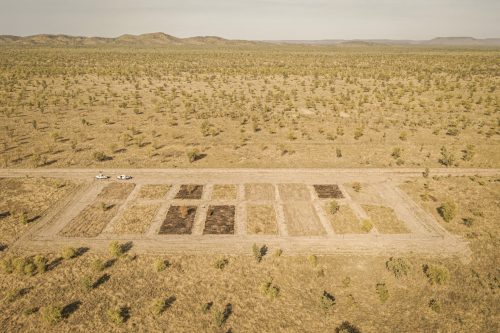
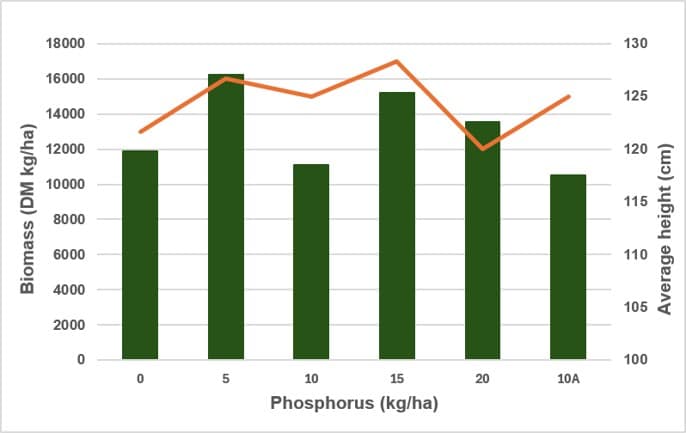
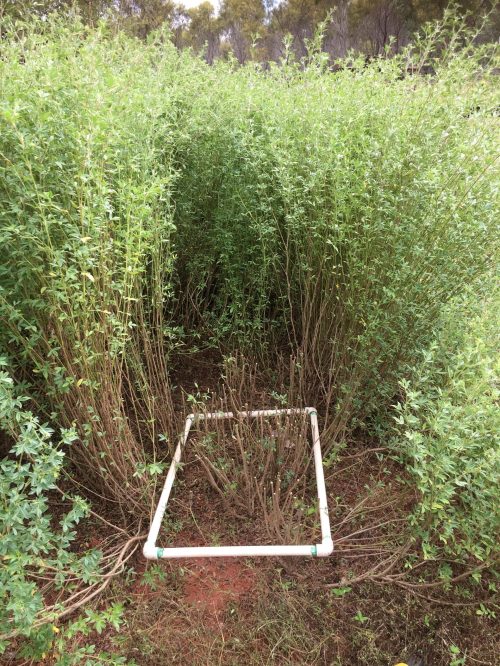
Replicated small plot trials were established on Diggers Rest, Country Downs and Alice Downs to assess factors relating to establishment such as sowing time, plus or minus phosphorus and establishment method. Most of these trials established well and some have produced spectacular biomass production in the second or third year.
Commercial seeding
The project has supplied seed to all the stations in the project for commercial-scale sowings (~50 ha) usually from the air by helicopter, although there was aerial seeding with a drone on two stations.
Collaborate with Queensland
The DPIRD-Northern Hub stylo project led a legume study tour to north Queensland in May 2025 hosted by the Queensland Department of Primary Industries scientist Dr Kendrick Cox and Craig Lemin. The study tour started from Cairns in north Queensland and headed west to the pastoral country around Mt Surprise and Georgetown before heading back to the higher rainfall Atherton Tablelands.
An outcome from this collaboration was two videos on ‘Over-sowing stylos and other legumes in northern Australia’
• Part 1: Benefits and getting started
• Part 2: Establishment
What have we found so far?
Establishment
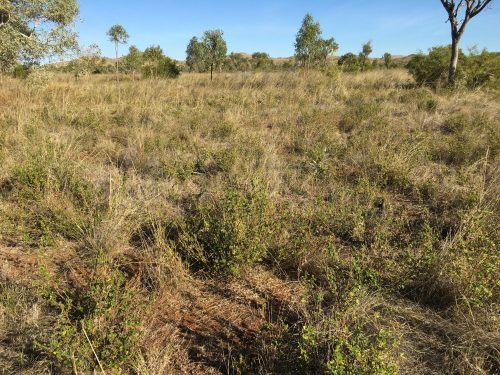
To date, across all the sites establishment has been highly variable and dependent on the seasonal conditions, site preparation (hard graze, burning), timing, soil type, pasture type and condition. Some sites have good establishment while some have had poor or failed establishment. Developing a reliable establishment package remains an elusive goal.
With the diversification permits given no soil disturbance and only permitted to broadcast seed either aerially or from the ground then seed to soil contact and predation by seed harvesting ants are issues. When aerially seeding a proportion of the seed can land in an inhospitable environment.
As a result, establishment is always going to be much lower than seeding into a prepared seedbed. However, to obtain a land clearing permit for improving native pastures is not feasible.
Amazing production in small plots
Some of the replicated small plot trials have had amazing production given favourable seasonal conditions. For example, the replicated stylo x phosphorus trial on Diggers Rest had an average stylo biomass of 13.1 tonnes DM/ha (Figure 5) and stylo time of sowing x P had similar results. It should be noted that these sites were ungrazed and the total stylo biomass does include some woody stems which are not edible biomass.
Persistence
Persistence monitoring has shown that the stylo plant density has increased across all sites (except one site which was largely burnt) after the initial plant establishment counts in the first dry season after sowing (broadcasting). For example, on the two small blocks on Dampier Downs the stylo establishment was 1.5 to 1.9 plants per square metre with 85-90% shrubby stylo and 10-15% Caribbean stylo. The persistence counts a year later in May 2026 showed an increase to 7.3-7.6 plants pe square metre which were 98-99% shrubby stylo. Evidence of ongoing recruitment has been observed at multiple sites, suggesting soil seed reserves may contribute to the maintenance of legume populations over time.
Shrubby stylo out-performing Caribbean stylo
A consistent finding across the WA demonstrations has been the superior persistence of shrubby stylo (Seca) compared with Caribbean stylo (Verano). At each site, a 50:50 mix of shrubby stylo (Seca) and Caribbean stylo (Verano) was sown. The initial monitoring recorded an average species composition of approximately 85% shrubby stylo and 15% Caribbean stylo. By 2026 persistence monitoring, shrubby stylo accounted for approximately 91% of recorded plants across monitored sites.
Site selection for over-sowing stylos
Number one rule is to select the best soils with the native pastures in good condition for over-sowing stylos. Keep in mind that a rest from grazing over the first two wet seasons to allow the stylo to establish is essential. Avoid sites that are rundown or in poor condition.
Guidelines
Select sites with:
• Deep, well drained, red-brown sandy and loamy earths
• Good density of palatable perennial grasses like ribbon grass pastures
Avoid sites with:
• Dense perennial grass growth and monocultures (e.g. spinifex, black spear grass)
• Sites in poor condition with large areas of bare ground or ephemeral annual species
• Stony and shallow soils
• Deep sands, especially sand dunes
• Clay soils, cracking clays even in medium rainfall environments
To find out more about this project please contact:
Northern Territory
Caroline Pettit: caroline.pettit@nt.gov.au
Western Australia
Geoff Moore: geoff.moore@dpird.wa.gov.au