
Background
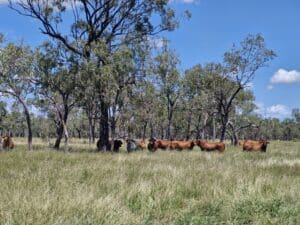
Chris Allingham’s family has been grazing cattle around Charters Towers since 1903, making them one of the district’s original pastoral families. Today, the family operates Fletcher Vale Station, a 41,000-hectare cattle property running approximately 3,200 head. The operation focuses on breeding cattle and finishing bullocks for slaughter. Rather than chasing maximum stocking rates or turning cattle over more quickly, Chris has always managed the business with a long-term philosophy centred on reducing risk and maintaining consistent productivity.
“You run a business for when things are bad, not when things are good.”
Chris believes northern grazing businesses should be built around surviving poor seasons rather than maximising returns during favourable ones. Throughout his career he has maintained conservative stocking rates, preferring to produce heavier cattle rather than simply running more animals.
“Weight keeps you in business.”
Nutrition has always been the major limitation to cattle performance at Fletcher Vale. While seasonal conditions determine pasture quantity, Chris believes pasture quality is the factor that ultimately determines how efficiently cattle move through the production system.
“Our inhibiting factor is nutrition. Everything is based on nutrition.”
Pasture improvement has been part of the family’s management for generations. Chris’s grandfather experimented with butterfly pea around the 1930s, while his father experimented with buffel grass and stylos and was an early adopter of practices aimed at improving pasture and grazing management. Early legume establishment was gradual and opportunistic, with seed broadcast by hand, applied through a small drum seeder and mixed into fortified molasses so cattle could distribute it through their dung. These early efforts laid the foundation for the much larger legume program underway today. Chris sees the investment as building on the work of previous generations while creating opportunities for the next.
“I’m benefiting from his legacy. By planting this, it’s my legacy to my kids.”
Practice change
Developing a broadscale legume establishment program
The severe drought of the 1990s reinforced the importance of improving pasture quality and extending the period of useful nutrition following the wet season. As the program developed, Chris moved from small-scale establishment to broadscale aerial sowing.
Large wildfire events in the late 2010s provided an opportunity to expand the program across substantial areas of burnt country. Chris considers fire one of the better ways of preparing a seedbed because it reduces pasture competition and exposes the soil surface. However, he does not believe producers should wait for ideal establishment conditions. Legumes at Fletcher Vale have established under a range of conditions, including into existing grass pastures.
A helicopter is now used to spread seed in 25 m wide strips spaced 50 m apart, centre-to-centre. This reduces the amount of seed required to treat large areas, with the longer-term strategy relying on established plants to set seed and progressively spread throughout the country through grazing.
Sowing generally occurs shortly after New Year, when summer rainfall has provided, or is expected to provide, suitable soil moisture. The current program uses a 5 kg/ha mix of Seca, Verano and Caatinga stylos, butterfly pea and desmanthus.
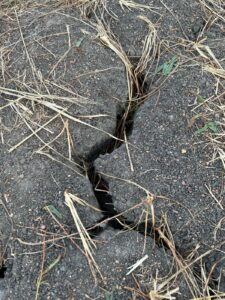
The program initially focused on Fletcher Vale’s red basalt country, where almost all suitable areas have now been planted or already contain reasonable stylo populations from earlier establishment efforts. Attention has since shifted to the heavier black cracking clays, which make up approximately 45% of the property, with around 15% of this country now planted.
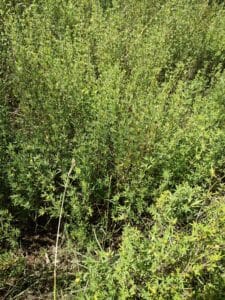
Seca stylo has proven particularly persistent on the red basalt country.
“I’ve always thought long term.”
Results were sometimes slow. Some early plantings appeared sparse for many years before seed production and favourable seasonal conditions allowed populations to expand.
“It probably took 15 or 20 years, but now that country is just chockers with Seca.”
Grazing management drives persistence
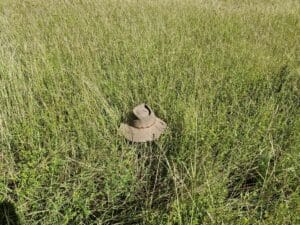
Chris believes what happens after sowing is more important than achieving a perfect seedbed. While fire has generally provided some of the best establishment opportunities, he has seen legumes establish following different levels of pasture disturbance and into existing grass-dominant pasture.
“We’ve burnt it, we’ve flogged it, we’ve done everything. Fire is probably the best, but the best thing is to put the seed out. The more important thing is how you manage it afterwards.”
Managing grazing pressure after establishment is critical. Wet season spelling is used where practical to give legumes an opportunity to grow, flower and replenish the soil seed bank. However, Chris acknowledges that completely spelling large areas is not always practical on an extensive grazing property. Maintaining conservative stocking rates helps reduce grazing pressure and gives established plants an opportunity to set seed even where cattle need to return to a paddock before the end of the growing season.
“If the plant’s grown away, they’ll only trim the top off. You’ll probably still get a significant amount of seed set.”
Once plants are established and producing seed, cattle become an important part of the process. Seed is spread in dung as animals move through the property, helping legumes colonise areas beyond the original sowing strips.
“The cattle will do the rest.”
Chris therefore recommends considering grazing pressure when deciding where to establish legumes. Areas close to water may appear attractive because cattle use them heavily, but this grazing pressure can make it difficult for young legumes to survive and set seed. Instead, establishing legumes towards the back of a paddock or in other less heavily grazed areas can give plants an opportunity to establish and produce seed. Cattle can then progressively carry that seed back into more heavily utilised country.
Matching legumes to land type
Experience at Fletcher Vale has reinforced that no single legume will suit every part of the property. Seca stylo has performed strongly across the red basalt country, but the heavier black cracking clays present different establishment and persistence challenges. Chris is therefore evaluating a broader mix of legumes as the sowing program moves onto this land type.
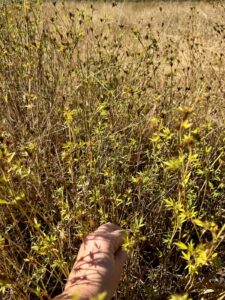
Butterfly pea has been particularly encouraging on the heavier soils, including flood-prone areas and cracking clay country.
“I’ve really been impressed with the butterfly pea.”
Butterfly pea is not new to Fletcher Vale. Small populations have persisted on the property for generations, and Chris had observed it gradually spreading before the current broadscale planting program began. This gave him confidence that it could have a greater role in the black soil pastures.
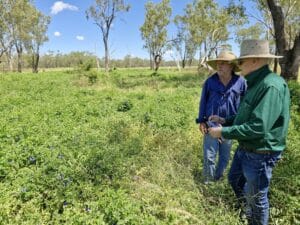
Desmanthus has also established, while Caatinga stylo has shown encouraging signs. However, Chris considers both to be at an early stage and believes more time is needed before drawing conclusions about their long-term persistence.
Rather than looking for a single “best” legume, the aim is to develop a mix of species that can persist across different land types and potentially extend the period of useful nutrition.
“We won’t be stopping. We’ll just keep trying different things.”
Chris also continues to look for low-cost opportunities to introduce seed. Uncoated legume seed is added to supplements fed to weaners, allowing cattle to assist with distribution. He is also investigating whether legume seed could be incorporated into manufactured hard feed blocks as another way of introducing seed into the grazing system.
“It doesn’t have to cost a lot every year. Just keep trying to make it better.”
Outcomes
Chris believes the main benefit of the legume program has been improving the nutritional value of the pasture and extending the period of higher-quality feed available to cattle. The objective is to reduce the length of time each year that cattle are under nutritional pressure, helping maintain performance further into the dry season.
Chris remains cautious about attributing improvements in cattle performance solely to legumes. Fletcher Vale has experienced a run of favourable seasons, and he recognises that seasonal conditions, genetics and other management changes all contribute to animal performance. However, he believes the established legume base is helping cattle make better use of favourable seasons and maintain access to higher-quality feed for longer as the season progresses. Importantly, the objective is not to use the additional feed to simply increase cattle numbers.
“We could run more cattle, but that’s not what we’re trying to do.”
Instead, Chris continues to favour conservative stocking rates, improved individual animal performance and a grazing system that is better able to cope with seasonal variability.
Key learnings
Chris’s experience highlights several practical lessons for establishing legumes across northern grazing country:
- Get seed out and think long term. Establishment can build progressively rather than covering an entire paddock in the first season.
- Manage grazing after sowing. Allow plants to mature and set seed to develop a persistent soil seed bank.
- Spell pastures where practical. Wet season spelling and conservative stocking rates can support establishment.
- Don’t wait for the perfect seedbed. Fire can create favourable conditions, but legumes can establish across a range of pasture conditions.
- Use livestock to spread seed. Establishing legumes in lower-pressure areas allows cattle to gradually distribute seed through the paddock.
- Match species to land type. Seca has performed well on red basalt country, while butterfly pea, desmanthus and Caatinga stylo are being assessed on heavier black soils.
- Keep improving. Small, regular seed investments can build legume populations without complete pasture renovation.
For Chris, better pasture nutrition is a major opportunity to lift cattle performance. Genetic gains can only be fully realised when nutritional limitations are also addressed:
“Why would I go out and DNA test all our herd to find the best cows when they can’t reach their potential anyway because I’ve got a nutrition problem?”
Ultimately, investing in legumes is about building a more productive and resilient grazing system that will continue benefiting the family into the future.
Written by Shannon Byrnes from Mareeba DPI, as part of the Queensland Pasture Resilience Program which is a partnership between the Department of Primary Industries, Meat & Livestock Australia and the Australian Government through the MLA Donor Company.
