
Pasture blues
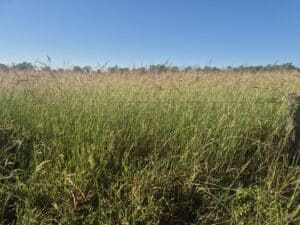
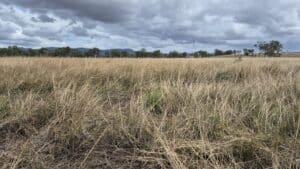
Vanissa Bailey manages 121 ha of her family-run property Palm Hill at Midgee, South of Rockhampton, for her Droughtmaster and Brangus breeder and weaner operation. The property is dominated by native Forest bluegrass (Bothriochloa Bladhii).
“We grow lots of grass in these paddocks, but we struggle to get the cattle to eat the Forest bluegrass, they won’t touch it even when it’s short and green. We also don’t have many legumes in amongst it. For us, the paddocks with lots of Forest blue are underperforming. Cattle will eat everything else but it. I have been looking for ways to increase our production off these paddocks and thought there had to be a way to make the pasture better.”
When she heard about an online training group teaching people how to plant new pastures, she signed up.
Online training to put into practice
The ‘Rockhampton online pasture group’ delivered by the DPI Queensland Pasture Resilience Program and FutureBeef staff ran four online sessions between August and December 2025 to teach graziers the steps of pasture planting. Covering everything from fallowing to seed selection.
“I decided to plant a 6 ha area to trial what I was learning. It was nice flat, clean country, we could get machinery there easily and I could control the access to the new pasture. Our family already owned some of the old machinery and equipment we used, but the farming concepts were totally new to me! Family members did some of the paddock operations for me and I think they thought I was crazy wanting to put in so much effort ploughing up grass to plant grass, but now they are impressed with the results and so am I!”
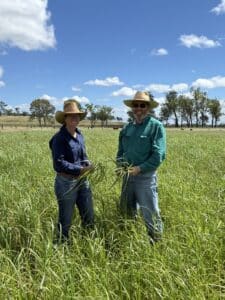
The steps Vanissa took to plant her paddock were:
- Soil test – determined that Calcium, Phosphorus and Nitrogen were low.
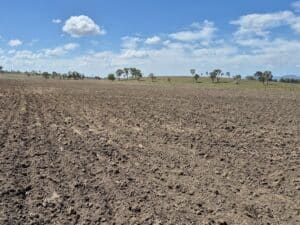
- Ploughed with offset discs first in October 2025 and then waited until more rain and weeds/grass germinated and ploughed again.
- Divided the paddock into three parts to test whether ripping with a) dozer or b) Yeomans or c) doing nothing, helped with more weed killing and preparing a seed bed. The dozer brought up big clods of deep clay, whereas the Yeomans created a nice even seed bed.
- Good rain at Christmas which germinated a lot of weed seed.
- Ploughed again to kill everything and break up clods that the dozer brought up. Soil was getting quite fine by this stage. Fertiliser was incorporated in this working. Two fertiliser options were trialled to address the limiting nutrients the soil test identified:
- 400kg/ha Cal-S,
- 200kg/ha Diammonium Phosphate (DAP)
- Rolled with a tyre roller behind tractor.
- 10 January 2026 – broadcast seed on top of the soil with a 12 volt spinner on the back of the buggy. 200mm of rain 4 days after planting.
- Rain rain rain – some spots got a bit waterlogged.
- No more significant rain within 2 months after planting – all plants were surviving on the germinating rain and stored moisture. Where the seeding rate was higher the pasture was looking great.
- Start of March good rain.
- March 2026 – first graze in strips so cattle just took the top off:
- Started with part of the paddock growing the best, grazed about half a day
- Then longer graze a few weeks later after rain. Had to wait until paddock dried out and roots were well anchored.
- Now spelled, waiting for flowering and seed set before grazing again.
During the fallow period (steps 1-6) there was 275mm rain. After sowing (step 7) 400mm rain fell until April 2026.
Vanissa also tried two different seed mixes.
- Epica Rhodes grass 8kg/ha, butterfly pea + desmanthus 10kg/ha
- Mekong + signal 8kg/ha, V8 + caatinga + Cardillo centro 4kg/ha
So what are the results?
“I am very happy – it turned out really well! I plan to do the other half of this paddock next summer. The cattle love the grazes they have had so far, so that is a huge positive for me. Turning this paddock with almost no grazing value into something they actually want to eat is a big achievement!”
“I am waiting to see which species mix goes the best over this year, but at the moment they both look great. There is a good amount of grass and legume throughout the paddock. Talking about the fertiliser though, it looks like the area with the DAP is the best, so I might just use it next time.”
“I have learnt lots through this process and I have some things I want to tweak next summer.”
Vanissa said one of her biggest learnings was about weed competition.
“I am thinking that I will start the fallow earlier so there are more chances for weeds to germinate and for me to remove them. I want to reduce the amount of weed seed in the soil more than I did this time. I am a bit worried about the weeds the paddock has now – where I put out less seed there are weeds. In those patches I feel like I have failed because the weeds weren’t there before. The undesirable grass wasn’t great but at least there were no weeds. But I can see that if I am careful with my grazing these new grasses and legumes should fill in those gaps. When I plant the next paddock, I am going to use a GPS when I put out the seed so I get even coverage over the paddock.”
She also said learning about the perfect seedbed was really helpful.
“Understanding how firm and fine a seedbed should be, was a tricky thing to learn, but I think I have it now. So next paddock I will use the offset disc plough at the start but might finish the fallow with some herbicide spray, so all the workings with the offsets don’t make the soil too soft and fluffy. If the soil isn’t so fluffy I might switch from using a roller to some harrows or a scarifier, but that will depend on what the seed bed looks like. I might do some trial areas of each. I also know that the boom spray behind the tractor will use less fuel than pulling the offsets around.”
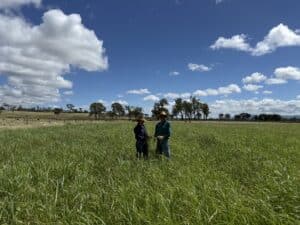
The online group created a unique learning environment for graziers. Once a month everyone would come together on Zoom and hear from Stuart Buck and Kylie Hopkins (DPI) about a pasture planting step. Sessions were delivered in time with when paddock operations should happen and with enough time to source things like seed, fertiliser and machinery. Group members could share their progress since the last session and discuss their next steps.
Vanissa said she enjoyed the online format. “I loved having a morning session once a month and then having the rest of the day to get back to work. I liked that we learnt something new and then had time to go away and work on it, we were able get back in touch for more advice if needed. I was able to send my soil test and seed reports and paddock photos through to Stuart between sessions and he would give me some advice so I could keep moving. I loved meeting new people in the area and seeing what they were doing and how they were going.”
What’s her advice to others wanting to plant a new pasture?
“Do it! But it’s like buying a bull – there are lots of sales pitches and you don’t know what you’re buying unless you do your research. Get a soil test. Get a germination report on your seed. Store moisture to give yourself a buffer if it doesn’t rain much after germination. We had a big germination event but no rain for 2 months after that and the pasture kept growing. I’d recommend getting some type of ploughing equipment or a spray rig for your fallow. We didn’t have a planter so I purchased a little 12 volt spreader for the buggy and it worked great.”
2026 online pasture group – broader Isaac district
For graziers in the broader Isaac district (Clermont, Dysart, Middlemount, Dingo, Valkyrie, May Downs, Clarke Creek) an online pasture training course will be delivered in 2026. For more information and to register your EOI, visit this link.
Written by Kylie Hopkins at Rockhampton DPI. This work is supported by the Queensland Pasture Resilience Program, a partnership between the Department of Primary Industries, Meat & Livestock Australia and the Australian Government through the MLA Donor Company.
