
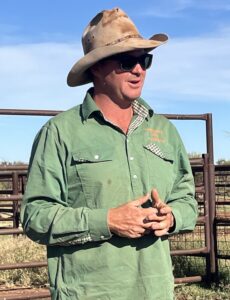
Ross Stanes
2026 is the International Year of Rangelands and Pastoralists, offering a unique opportunity to showcase our landscapes and people that shape Central Australia. Covering around 75 per cent of the country, the Rangelands are synonymous with the outback, and this vast environment is deeply embedded in Australia’s culture and identity.
‘Respect: A strong feeling of approval of somebody because of their good qualities or achievements.’ – Oxford Learners Dictionary
Department of Agriculture and Fisheries Livestock Extension Officer Caleb Schwartz recently visited Ross and Jo Stanes, who manage Lyndavale Station and the Lyndavale Cattle Company, located 280km south-west of Alice Springs.
The station encompasses vast mulga grasslands, sweet calcareous country, southern bluebush landscapes, and the fascinating salt lakes of Karinga Creek across the northern parts of the property. The Lyndavale Cattle Company also includes nearby Mount Ebenezer and De Rose Hill stations, as well as property in South Australia.
On the drive in, there was a certain excitement, and first impressions do last: a well-kept yard, happy kids with the dogs at their heels, and a warm welcome.
It soon became apparent that whatever Ross does, he does well. That started with the coffee and continued throughout our tour of the property.
During the drive Ross spoke proudly of what he loves about his work.
‘I love managing a herd and a landscape – essentially we’re just managing a landscape, and in seasons like this, it’s nice to see your work pay off,’ Ross said.
Excellent rain in March 2026 produced abundant pasture, of which Ross pointed out, some is being ‘locked up’ to be grazed the following summer.
A common theme amongst those that are respected in their field is their ability to be a lifelong student. Ross is a mechanical engineer by trade, with experience as a project manager. Since returning home to Lyndavale, he has sought out numerous courses, from cattle nutrition and stress free stockmanship, through to leadership skills.
The cattle reflect this philosophy of continuous improvement. Calm and content. Well-bred and well handled with white coats and moderate frames, to fit the environment. Low stress stock handling is a highly regarded aspect of their business.
‘We put our staff through a stress free stockmanship course every year. It pays off with ease of handling, efficiency and animal performance,’ he explained.
It is an example of the deliberate intent to doing things purposefully at Lyndavale.
Ross credits much of his land management knowledge to his parents, John and Anne Stanes.
‘My parents were very good land managers and did a lot of Landcare work.’
Understanding how the landscape functions is very important to the Stanes family. Ross’ ability to observe and interpret what is happening in the landscape and identify different pasture species and their value in his business, is second to none.
‘Being able to identify grasses is critical for management. It is the starting block – knowing what’s there and what should be there,’ Ross said.
‘Most pastoralists aren’t just growing cattle. They’re managing the landscape, and they are doing their best.’
It is an environment that requires a successful pastoralist to be highly adaptable.
‘Being open minded and willing to change is important,’ says Ross.
‘Doing things the way they’ve always been done is possibly the worst thing you could do.’
When asked what contributes to business success, Ross laughed.
‘We look at our business as it were any business. What makes us profitable? What are our barriers? What can we do about them?’
Attracting and retaining great staff is a common challenge for pastoral businesses. However, it’s apparent that people like Ross and Jo are leading the way in creating an environment where you would want to live and work. Aside from good conditions and career development Ross added that the biggest thing in managing people is seeing our own flaws.
‘We need critical thinking. Don’t just accept everything you’re told – think and assess things for yourself,’ he said.
It’s clear that Ross does this in all aspects of his role as a pastoralist – that might be why the respect he holds is so duly deserved.
Additional resources
What does it mean to be a Pastoralist? – Paul Smith →
