
Key takeaways
- Ground cover can slow runoff, trap sediment and help repair eroded areas
- Spreading runoff can keep more water and soil in the paddock
- Watching where water moves helps identify where erosion control may make a difference
- Learning from others helped David design an erosion bank that suited his own country
- Starting on small erosion problems can avoid a much bigger job later
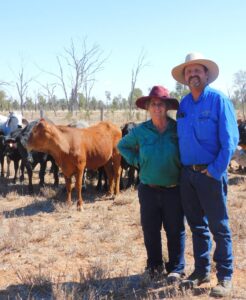
David and Lynette Keene have spent years learning from their cattle and country.
Together with their daughters, Ellen and Breanna, they run Northdown Cattle Company across three Central Queensland properties — Northdown near Emerald, Garden Creek near Springsure and Mafeking near Jericho.
They’ve built the business from one acre and 23 cattle around 25 years ago to around 10,800 ha today, but their approach remains hands-on. They watch what’s happening, learn from others and try things for themselves.
At Garden Creek, that approach led them to look more closely at how water moved across the property during heavy rain and what they could do to slow it down and keep more of it on their country.
Slowing the water down
The Keene’s had already seen what better ground cover could do at Garden Creek. Through rotational grazing, the increased ground cover was slowing runoff from neighbouring properties and trapping the soil it carried.
But during heavier rain, water was still concentrating in a gully on the property. Although their grazing management had reduced the erosion, water was continuing downstream and causing further damage.
David and Lynette began looking at whether an erosion bank could help take pressure off the gully by slowing and spreading the runoff, keeping more water and soil on their country.
“We don’t want it running off and going. We want to use as much of that water as we can.”
An erosion bank is a raised earth bank built across the path of runoff to slow and redirect the water. At Garden Creek, the idea was to slow the flow and spread the water across more of the surrounding country rather than letting it continue quickly down the gully.
To work out what might suit Garden Creek, David looked at what others had already tried.
At a field day at Spyglass Beef Research Facility in the Burdekin, David saw gully remediation work led by Simon Hunt, a Charters Towers-based soil conservation officer with the Queensland Department of Primary Industries. What appealed to David was the practical, hands-on approach — seeing what had been tried on the ground and hearing what had and hadn’t worked.
David also researched the work of the Mulloon Institute, a not-for-profit organisation based in southern NSW that works with landholders to improve landscape health, including slowing runoff and keeping more moisture in the soil. He also spoke with Fitzroy Basin Association and others with experience in landscape repair.
Rather than copying any one approach, he took what he’d learnt and applied it to Garden Creek.
By the time someone from the Mulloon Institute came to help determine where the bank should go, David had already pegged the location he thought would work. After checking the levels, they agreed he’d picked the right spot.
Putting the idea into practice
David and Lynette built the bank themselves using their own machinery.
They established the level line, then used loaders, dozers and graders to build the bank. Soil was pushed up from the front, with additional material from a nearby borrow pit used to make the bank wider.
The finished bank is around five metres wide at the base, three metres across the top and 100 metres long. Both ends allow excess water to flow around the bank, with the southern end directing water onto a ridgeline.
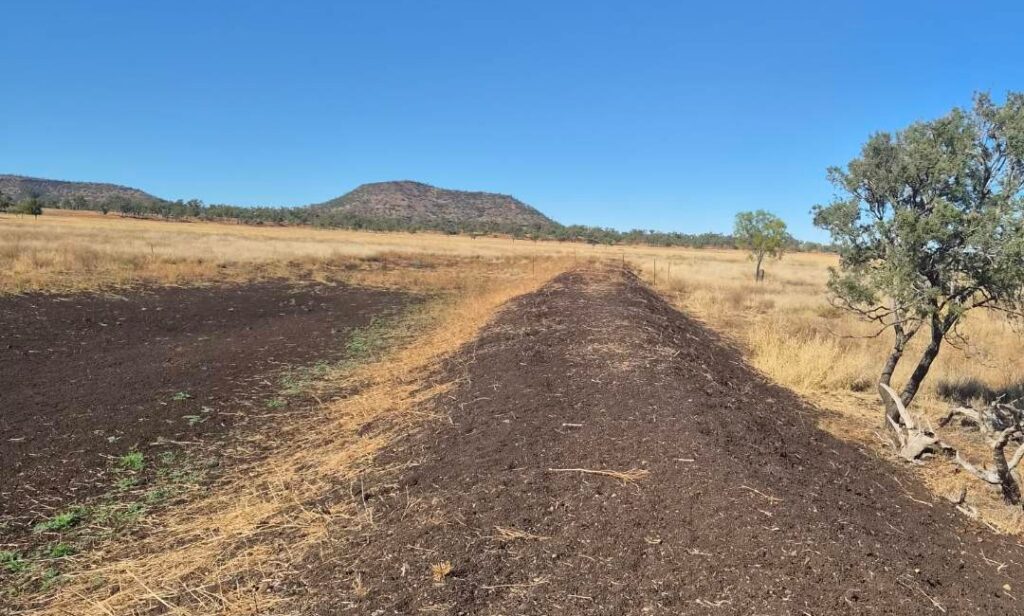
From there, the water spreads in two directions across the surrounding country before eventually returning to the main drainage line further downstream. Spreading the runoff over more country slows the flow and gives more of the water a chance to soak into the soil.
David estimates they spent around 50–80 hours constructing the bank. Someone experienced in this type of earthwork could have completed it faster, but learning how to do the work themselves was part of the process.
“We’re going to learn the skills ourselves.”
Putting the bank to the test
The bank was finished in October 2025, just ahead of the wet season.
Around 120 mm of rain fell through January in smaller falls, followed by another 100 mm during February. Then, in March, 109 mm fell in less than 24 hours.
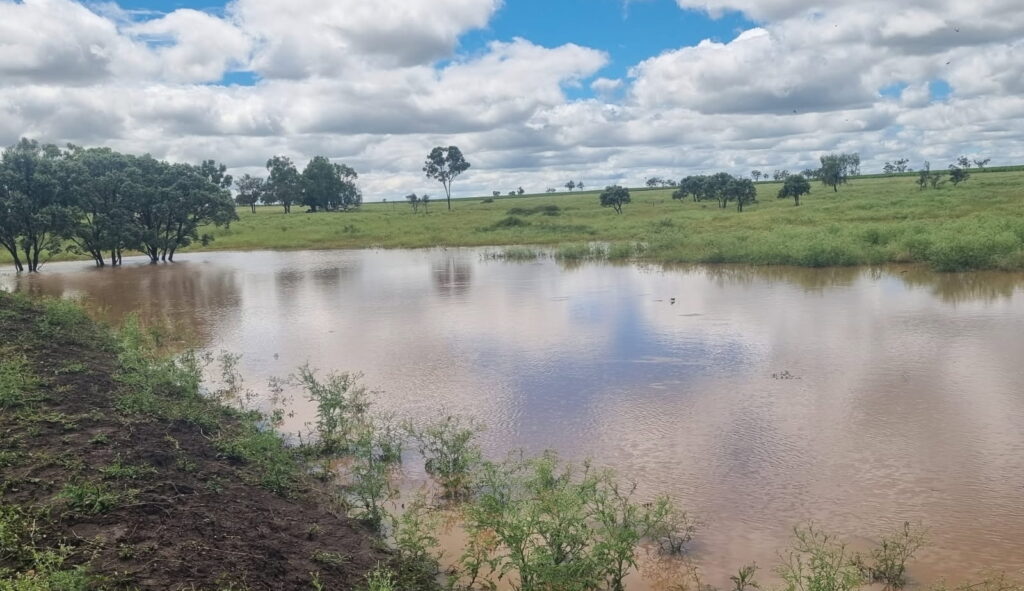
The bank filled, holding back water that would normally have continued down the gully. For David, one of the most noticeable differences was below the bank, where the grass hadn’t been flattened by the flow of water.
The bank’s first wet season showed David how it performed and where it might need adjusting.
The water came to within 200–300 mm of the top, much closer than the 500 mm clearance they’d planned, so David intends to raise it slightly.
“When you send water somewhere, you don’t know what it’s going to do until you see what it does.”
David is already thinking about what might come next, including another bank further down or smaller works to slow any water that continues past the diversion bank.
Keeping more in the paddock
The bank has only been through its first wet season, so David and Lynette aren’t rushing to draw conclusions yet.
But they’re already seeing signs of what keeping more water in the paddock could mean. Even when the surface looks dry, there’s still moisture underneath — something David discovered when he got his motorbike bogged while riding across the paddock.
That extra moisture is showing in the pasture too. “The grass there is just phenomenal,” says David.
When cattle went into the paddock, David and Lynette expected them to make a noticeable dent in the available feed. By the time they came out, it looked as though they’d “hardly even touched it”.
For David, it’s about making the most of the water they’ve got:
“It’s just irrigating the country with free water.”
Catching the small problems early
The large bank at Garden Creek is only one part of the Keene’s approach to managing erosion.
At Mafeking, David has been using much smaller grader banks for close to 10 years.
When they bought the property, there was an existing gully around two metres deep along one fence line. Rather than wait for similar problems to develop elsewhere, David began putting small banks along a nearby firebreak to slow the water before it could concentrate and start another gully.
They’re deliberately small and simple. David has built around 8–10 of these banks using a grader, without needing a dozer. He keeps them small enough to grade out and put back in when maintaining the firebreak, with each bank taking around 20–30 minutes to rebuild.
Nearly a decade later, David says there has been no further erosion in the area.
“It takes no time at all to stop water in the early days. If you let it go more than two years, you’ve got a big job.”
Whether it’s a small grader bank at Mafeking or the much larger bank at Garden Creek, David’s advice is simple: watch where the water goes.
“Be there on a rainy day and see where the water flows.”
More information
Read about gully remediation trials at Spyglass Research Station →
See how Cubbaroo Station addressed erosion following drought and flooding →
Learn how alluvial gully remediation can help reduce sediment reaching the Great Barrier Reef →
Explore practical options for preventing and rehabilitating gully erosion →
