
Producers: Cam and Fred Whiting
Location: Atherton Tablelands, Queensland
Properties: Home Farm, Malanda and Yungaburra Farm
Home Farm: Breeding – Approximately 170 acres
Yungaburra Farm: Finishing – Approximately 125 acres
Enterprise: Beef breeding and finishing
Key learnings
- Match the method to the business. Whole-paddock establishment provides faster results, while strip planting can reduce upfront cost and disruption to grazing.
- Keep small seed shallow. Aim for good seed-to-soil contact without burying small legume seed too deeply.
- Allow time. Cam’s earliest strip plantings have continued to develop over five wet seasons.
- Consider how species spread. Vigna has spread well beyond Cam’s original planting strips, while glycine has remained closer to the planted rows.
- Use cattle where appropriate. Hard seed fed through supplements can establish new patches over time but there is little control over where it goes.
- Consider seed quality as well as price. The amount and viability of actual seed should be considered when comparing bare and coated products.
- Decide how quickly you need the result. Full establishment can provide a productive pasture sooner, while gradual establishment allows pasture improvement to occur while most of the paddock remains available for grazing.
Background
Pasture legumes have been part of the Whiting family’s grazing system on the Atherton Tablelands for more than 30 years.
Fred Whiting established much of the improved pasture at Yungaburra Farm in late 1993, with a further 12-acre (4.9 ha) finishing paddock developed around 2000. His approach involved conventional paddock preparation and sowing the whole area and then excluding cattle while the pasture established. Under favourable conditions, productive legume and improved grass pastures developed within about 12 to 18 months.
His son Cam has taken a different approach at Home Farm in Malanda. Taking whole paddocks out of production for renovation would reduce the grazing area available to the breeding herd, so Cam has been introducing legumes gradually into existing pastures by planting strips.
“Let’s sneak it on cost effectively and with the least disruption to the show.”
The two approaches provide a useful comparison. Fred’s whole-paddock establishment produced a faster result, while Cam’s strip planting reduces upfront investment and allows most of the paddock to remain available for grazing.
Establishing legumes in strips
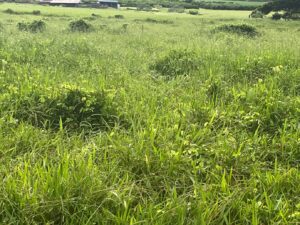
Cam’s first approach involved establishing legumes in approximately 2 m wide strips spaced 10 to 20 m apart through existing pasture.
A small rotary hoe with straight blades was used to lightly disturb the soil surface. Creeping vigna and glycine seed was broadcast by hand and heavy chains dragged over the strips, with cattle also helping press seed into the soil.
Establishment initially appeared patchy, but the first strips are now in their fifth wet season. The creeping vigna has progressively spread beyond the original planting areas and Cam estimates it now accounts for approximately 20 to 25% ground cover in parts of the treated area.
“Don’t look at it for the first two years.”
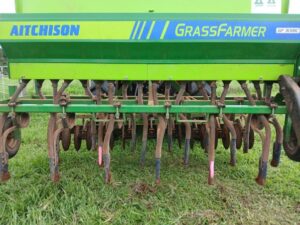
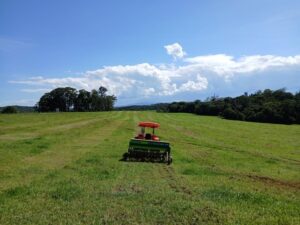
Cam has since refined the approach using a minimum till planter. He recorded the inputs and costs from his December 2025 planting to provide a practical example of what strip establishment involved.
Planting was completed on 24 and 26 December 2025 across approximately 30 acres (12 ha). Because only strips were planted, the actual area sown was about 10 acres (4 ha).
The 63 kg seed mix contained:
- 4 kg Creeping vigna
- 4 kg Cardillo centro
- 10 kg Tinaroo glycine
- 4 kg Greenleaf desmodium
- 2 kg Hughes stylo
- 25 kg Calypso cowpea
- 10 kg Rongai lablab
- 4 kg Mossman soybean.
This equated to approximately 6.3 kg/acre (15.6 kg/ha) within the planted strips. Although this might seem like a high seeding rate, it is still relatively low over the whole paddock (5.3 kg/ha).
The larger-seeded cowpea, lablab and soybean provided relatively inexpensive bulk in the mix and produced larger plants that cattle readily grazed. Cam felt this helped divert grazing pressure from the smaller, slower-establishing perennial legumes. The disturbed strips also made it easier to identify the original planting rows once the surrounding grasses had grown back, helping Cam monitor establishment and assess how far the legumes had spread.
Keeping establishment affordable
The seed cost approximately $1,800, with a further $300 for fish emulsion, applied at approximately 4 L/acre (9.9 L/ha). Around 100 L of diesel was used, bringing the recorded establishment cost to approximately $2,300.
With about 10 acres (4 ha) physically planted, this equated to approximately $230/acre ($568/ha) of planted strip, or $77/acre ($190/ha) when averaged across the total 30-acre (12 ha) area.
Keep small seed shallow
Planting at the right depth has been one of the strongest lessons from Cam and Fred’s experience.
Even with a purpose-built minimum-till planter and favourable wet season conditions, establishment was variable. Some rows developed strong legume populations while sections only metres away had little emergence.
Cam and Fred believe some of this variation resulted from small legume seed being planted too deeply. Their experience suggests good seed-to-soil contact is important, but it is more important for the smaller seeds to remain close to the soil surface.
Cam’s earlier method of broadcasting onto lightly disturbed soil and dragging chains over the seed produced patchy establishment, but in some areas performed as well as the drilled plantings.
“Planting depth is critical, I’d say.”
Vigna suited to gradual establishment
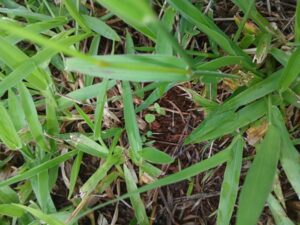
Of the species Cam has trialled, creeping vigna has performed particularly well.
“To me, the vigna’s doing the best by miles.”
Glycine has established successfully but generally remains close to the original planting rows. The creeping vigna has spread further laterally, with rows originally separated by around 20 m beginning to join in some areas.
Cam is also introducing creeping vigna by feeding seed through supplements and allowing cattle to distribute hard seed in their dung. At Home Farm, patches have developed in an area where Vigna has never been mechanically planted, with some reaching approximately 10 m in diameter around locations where cattle regularly congregate.
This provides another low-cost establishment pathway, although Cam recognises that both strip planting and livestock distribution require patience.
Cam joked “by the time I’m Dad’s age, it’ll probably be pretty good. Someone’s going to really enjoy it down the track.”
Seed quality matters
Cam considers seed quality and the amount of actual seed purchased, rather than comparing products solely on price per kilogram
He prefers bare seed where practical. Cam recently purchased uncoated creeping vigna for approximately $220/kg and considered it better value than some cheaper coated products because a greater proportion of the purchased weight was actual seed.
Variable germination between seed lots has further reinforced the importance of seed quality, regardless of the establishment method used.
Linking pasture improvement to cattle production
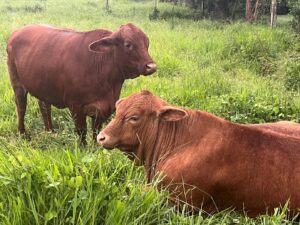
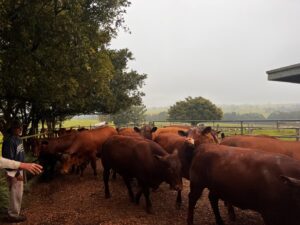
Home Farm at Malanda carries approximately 55 to 60 breeders, while Yungaburra Farm generally carries around 70 to 100 growing cattle, depending on seasonal conditions.
Weaners move to Yungaburra Farm and progress through several paddocks as they grow. The lead cattle are eventually moved into a highly productive 12-acre (4.9 ha) finishing paddock containing a strong mix of legumes and improved grasses.
Around 8 to 10 head are generally run in this paddock at a time. The low grazing pressure maintains high-quality forage, with the aim of keeping cattle progressing towards sale at approximately 0.6 kg/head/day liveweight gain.
“Everything’s got to keep going forward.”
Growing cattle also provide flexibility during poorer seasons because numbers can be reduced relatively quickly if pasture availability declines.
Outcomes
Fred’s experience shows that whole-paddock establishment can produce a productive pasture within 12 to 18 months where the business can afford to take the area out of production.
Cam’s approach is deliberately slower. After five wet seasons, creeping vigna is spreading beyond the original strips, with some widely spaced rows beginning to join. Feeding seed through cattle has also established patches where no mechanical planting has occurred.
For Cam, the trade-off is grazing time. Strip planting allows him to start improving pasture at a manageable cost while maintaining grazing across most of the paddock.
“If you’re locking a paddock up, maybe do the whole paddock to get a quicker result.”
For Cam, the priority is to start improving the legume component at a cost and scale the business can accommodate and relying on successful plants to naturally establish and expand over time.
Written by Shannon Byrnes from Mareeba DPI, as part of the Queensland Pasture Resilience Program which is a partnership between the Department of Primary Industries, Meat & Livestock Australia and the Australian Government through the MLA Donor Company.
