
Feeding legume seed to grazing cattle in a dry season supplement is a method of legume sowing that has been used for decades in the native pasture areas of Queensland. It is one way that Seca stylo has been established and then naturalised across the monsoonal zone in north Queensland and the low rainfall areas of western Queensland. However faecal seeding is not as simple, fast or successful as it sounds, and the results depend on many factors. This article summarizes the situations where faecal seeding may be a possible legume establishment option, the risks to manage, how effective it really is, and the tips to follow.
Lower up-front cost, but slow and risky
In paddocks where you can use machinery, planting legume seed into a sprayed-out pasture or a prepared seed bed should be investigated first. In most regions in arable situations, using machinery to prepare and sow legumes in strips into an existing pasture, or across the whole paddock as a complete pasture renovation, is a profitable option. Although it is a more expensive process, economic analyses from northern, central and southern Queensland shows that there is significant return on investment in planting legumes using sound agronomic techniques and a new and productive legume-grass pasture can be fully established within 1-3 years. Payback periods are often longer than this, due to the upfront costs of planting a pasture, however returns on investment are positive in the long term.
For more information on pasture planting techniques in SQ and CQ check out this factsheet.
For more information on pasture planting techniques in NQ check out this webinar.
Graziers commonly consider faecal seeding as an alternative low-cost option because no machinery is required, but it might take about 10-20 years to achieve a significant legume population in the pasture. Previous research across Queensland shows that at least 30% of the pasture biomass should be legumes to achieve an increase in cattle liveweight gain and obtain the nitrogen cycling benefits of legumes, but this will take many years (or decades) to achieve through faecal seeding.
Faecal seeding has a high risk of failure compared to other sowing techniques. Uniform seed distribution across paddocks is rarely achieved. Often most seed ends up in cattle camps and around water points and unless the paddock is de-stocked, seedlings establishing in these areas are at more risk of being trampled or eaten, and must compete with high weed populations that usually plague these areas. Also, many seeds are concentrated in each pat of faeces where few survive due to competition with each other.
Successful germination and establishment are at the mercy of the weather, so timing and seed choice is important (more on that later). Without removing the grass competition, preparing a seed bed and storing moisture (which is the recommended technique for CQ and SQ), the germinating seedlings need enough regular rain to grow and set more seed. Finally, there is no way to inoculate seed with rhizobia (if needed) so the long-term productivity of the legumes can be compromised.
As an alternative, aerial seeding is a mid-cost option which rapidly achieves even spread of seed over large areas. Also, the establishment rate is higher and the result is achieved faster than faecal seeding (albeit it’s still significantly slower than using ground machinery to prepare a seedbed and sow seed). Generally, the paddock is burnt and seed put out into the ash bed before the first rain of the season is received. Read about aerial seeding at Charter Towers here.
Grass competition must be low
Faecal seeding can be considered where grass competition is low:
- land types with sparse native pasture generally on lower fertility soils, and
- access or ground conditions prevent use of cultivation or seeding machinery due to slope, gullies, rocks or timber, or
- aerial seeding is deemed too expensive.
These areas can occur across rainfall zones, but generally the best results from faecal seeding occurs in:
- the monsoon regions of northern Queensland with a short but extremely reliable wet season with summer rain over 1,000mm (where there is enough moisture for everything to grow), or
- the low average annual rainfall regions of western Queensland – 500mm or less falling mostly in summer.
Faecal seeding is not recommended for areas where:
- there is heavy grass competition from buffel grass, Mitchell grass or other dominant grasses (sown or native), or
- soil is fertile, resulting in high grass productivity, or
- machinery can easily access the country to cultivate or spray out existing grass, or
- aerial seeding is cost effective, or
- rainfall is summer dominant but not monsoonal i.e. 600-800mm a year, or
- rainfall is consistent throughout the year over summer and winter.
As an example, faecal seeding of desmanthus seed into a buffel grass pasture was trialled on a property near Wandoan in CQ in 2018 and the result was very poor legume establishment – read more here.
If faecal seeding is still deemed to be the best way to introduce legumes into existing grass pastures, the following sections will assist in reducing the risk of failure.
Late in the dry season is best
Add seed to the supplement late in the dry season when there is the best chance of a seasonal break and follow up rain within 2 months. September to December is roughly the right time. Feeding earlier in the dry season (e.g. June) runs the risk of a single rainfall event germinating seeds but no follow up rain occurring to keep them alive. Even if no early rain is received, some seed will die in the meantime and can be carried away or eaten by ants or other insects. Feeding during the wet season is too late – existing pasture will already have responded to rain and will be too competitive for new legume seedlings.
Seed quality is critical
Just like sowing seeds into a prepared seedbed, seed condition and quality is extremely important. Follow these tips on what seed to use:
- Small, hard-coated legume seeds are best, such as stylos and desmanthus. Hard coated seeds are more likely to withstand chewing and rumination. Rumination acts as a way of scarifying the seed.
- Scarified seed can be used, but more will be destroyed during digestion than using unscarified seed.
- Use bare seed, do not use coated seed.
- Use dormant seed. Seed should be as freshly harvested as possible to maximise the proportion of hard seed (dormant legume seed is called ‘hard %’ on a seed germination test). Aim for at least 50% hard on a germination test. Having a high proportion of hard seed reduces the risk of failure due to a false start in the season. Seed with a high germination % (listed as ‘germination %’ or ‘normal %’ on a germination test) is more likely to germinate following an early shower and then die when there is no follow up rain. For more information on how to read a seed germination report, check out this page.
- Do not store seed in the paddock or in hot sheds. Mix and distribute seed out of storage as it is needed. Seed should be stored in a cool, dry environment. Cold rooms or freezers are best.
Even seed spread is the goal
To ensure cattle readily eat the seed and spread it as evenly over a paddock as possible, follow these tips:
- Feed out enough seed over the grazing period to sow the paddock at a minimum of 2kg/ha.
- Mix seed up to about 10-15% of the supplement mix so cattle readily eat it. Be sure to account for how the seed might dilute other ingredients in the supplement when calculating the protein and energy intake per head.
- Position multiple lick feeders strategically around the paddock to maximise the spread of seed in faeces across a paddock. This may mean moving feeders regularly and keeping them away from water troughs. Faeces is often concentrated in cattle camps and around water points and supplement feeders. Forcing cattle to move between them and across different parts of a paddock will help reduce the concentration of seed in these areas.
Post faecal seeding grazing management
As with any pasture establishment method, grazing management in the first few years can mean the difference between success and failure. Grazing should be managed with an end goal in mind – in this case it should be to allow the new legumes to grow and set seed in the first year. Unfortunately, there is no one-size fits all for grazing management with faecal seeding and pastures should be regularly monitored to make informed management decisions. Setting up monitoring sites to record the increase in legume population can help. Learn how to set up monitoring sites here.
General grazing management tips for faecal seeded pastures:
- In the wet season, cattle selectively graze fresh green grass and tend to eat less legumes. Grazing in the wet season can mean that cattle spare the newly germinated legume seedlings. However, trampling must also be considered, especially if even distribution of legume seed has not been achieved. An early-wet season spell might be needed for seedlings to get some size before being put under pressure from cattle.
- As grass hays off as the season turns dry, cattle select more legumes in their diets. This is often when legumes are flowering and setting seed and should not be grazed. After seed has dropped, grazing can occur again.
Grazier experience with faecal seeding – Stratford Station, Jericho
Owned and managed by Robyn Adams
Robyn’s own words about faecal seeding of grass and legumes on Desert Uplands country.
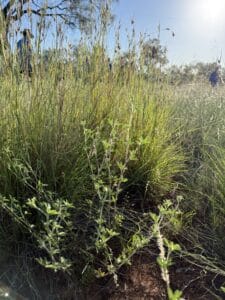
Basics and background
I purchased Stratford twenty-five years ago in a very run-down, long-unmanaged state, with few waters, no effective fences and able to run about 150 breeders.
Most of the property is Southern Plateau Land System, the most prevalent of the Desert Uplands Bioregion. It’s mostly open woodlands of silver leaf ironbark, with native pasture species of spinifex, wire grasses and wanderrie on red sandy soils.
With improved management through upgrades in water, fencing, supplementary feeding, some wild fire containment, genetics and breeding, the carrying capacity has gone from 150 to 600 breeders plus progeny. Part of this is the improved pasture through fencing and smaller paddocks enabling wet season resting and post-drought rebuild.
Experimenting
About five years ago, with the wet lick* becoming our preferred way to get enough phosphorus into the breeders, we started experimenting with buffel grass and legume seeds in this lick. We now use it for all classes of cattle and in all paddocks (13,700ha).
We add the seeds from September through to Christmas, or significant rain/seasonal break (or pimelea outbreaks). We put out about two good handfuls of seed per 300/400 litre trough. These are black poly crescent troughs, that are low enough for calves who start following mum’s habits, which they do quite early, generally. (It also develops their taste for the bitterness of urea and phosphorus, which if fed inconsistently, takes time for the cattle to ‘get back on’).
We use buffel seed that is harvested on Stratford, so it’s adapted both environmentally and geographically and cash-free (just our in-kind costs). We blend the buffel grass with the bought legume (uncoated) seeds. We have used various commercial legume mixes, probably about a third of a tonne in total by now.
Early on, we tried it in the bull paddock. After rain, we saw small clusters of seedlings coming from what was the remains of dung pats. Generally, though, we’ve observed it takes two to three years to ‘notice’ the plants coming through. Resting paddocks has increased plant health and density (including all pasture species). It also allows for the establishment of the seedlings. It’s the paddocks with the most rest and spelling that have had the best results for establishment and increase in the legumes.**
One of the main reasons we use faecal seeding (aware that there’s a high rate of non-viability once it goes through the bovines’ rumination and digestion) is the ease and low input ‘costs’ of adding it to the wet lick. When there’s a pimelea outbreak, we also add biochar (if we can procure the appropriate quality). Also, the dung beetles bury the seed with the dung, so these earth sarcophaguses protect the seed from wind and water erosion and heat (if dispersed ‘ordinarily’) and the seedlings have a better chance because they don’t ‘come away’ with a little rain – need enough rain to penetrate down to the buried dung balls.
Many of the ‘improvements’ executed on Stratford may seem insufficient for the input costs (time, effort, dollars) involved. However, I’ve always preferred to render the assessment with a long view, and not chased the silver bullets. One of my strategies is ‘collective incrementalism’, lots of small bits create, co-create and reinforce positive change together. It’s also reflective of how I saw my father, uncle, cousins and regional operators do bits over time, often seemingly negligible (seeds in the saddle-pack with its corner hole), that becomes quite transformative later on. So, is it worth it? …. Always, a tough scientific/academic question, when you’re trying to hear and access the trumpet in an orchestra.
*Wet lick – SupaFlo from Wilmar. Post-ethanal liquid with centrifuged-killed yeast/protein @ 10%; with phosphoric acid (food acid 388) added all year round; and seasonal adjustment for urea – from 3 to 6%.
** Please note that from Paul Jones’s (DPI, deceased) research trials, that the double wet rest is now considered critical for the establishment of new pasture plants. For Stratford, this has been very true, especially for Queensland Blue, which is becoming an important native pasture plant now for winter feed, and self-seeding. I am also starting to think there is something in the root zone becoming deep enough to access the slightly more fertile areas below the washed-out top layers in these ancient red and pink sandy soils. A thought bubble to ponder another time.
Written by Kylie Hopkins, Bernie English, Craig Lemin, and Ted Callanan from Rockhampton, Mareeba and Toowoomba DPI, as part of the Queensland Pasture Resilience Program which is a partnership between the Department of Primary Industries, Meat & Livestock Australia and the Australian Government through the MLA Donor Company.
