
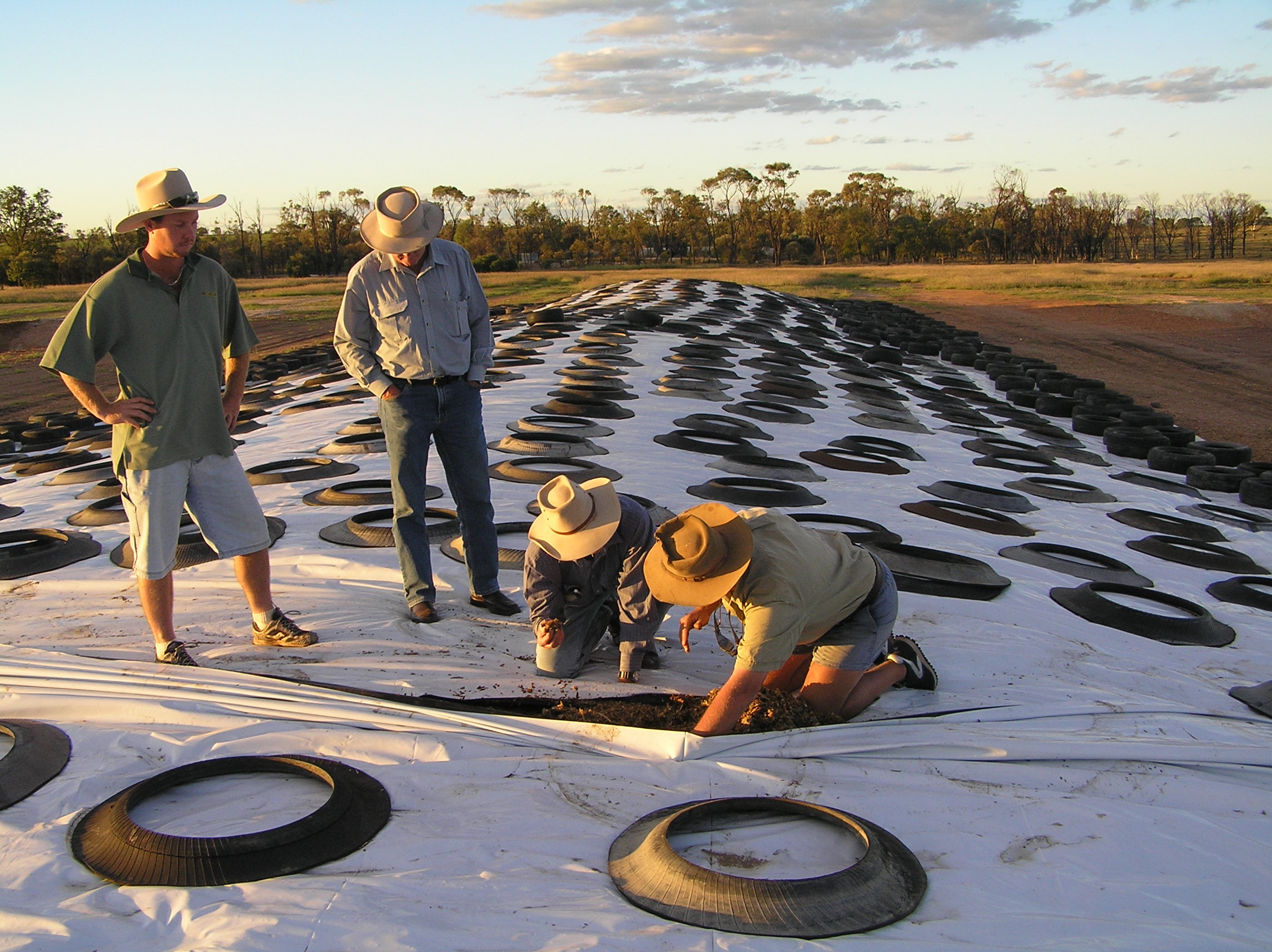
Hay and silage quality is impacted greatly by stage of maturity. As forage crops mature fibre increases while digestibility and crude protein decreases.
A basic nutrient analysis will measure forage moisture, fibre, energy and protein. These figures contribute in balancing the diet and estimating intake levels relative to performance. An example silage analysis is listed below on a ‘dry matter’ (DM) basis. Additional tests can be made for minerals. Since silage is a fermentation product estimates can be made for silage fermentation quality (pH and ammonia–N) and corrections can be made for volatile compounds lost during oven drying.
| Moisture | 68% |
|---|---|
| Dry matter (DM) | 32% |
| Protein | 7.2% |
| Acid detergent fibre (ADF) | 38% |
| Neural detergent fibre (NDF) | 57% |
| Digestible protein | 5.2% |
| Digestible dry mater (DDM) | 61.3% |
| Total digestible nutrients (TDN) | 61.5% |
| DM intake % of body weight | 2.1% |
| Net energy - lactation | 5.7 MB/kg DM |
| Net energy - gain | 3.2 MJ/kg DM |
| Net energy - maintenance | 6.2 MJ/kg DM |
| Relative feed value | 98 |
| Metabolisable energy (ME) | 9.3 MJ/kg DM |
Using the figures
The analysis enables us to estimate intakes of dry matter, energy and protein. Using a 300 kg steer as an example the analysis estimates an ‘ad lib’ intake of 2.1% of body weight in dry matter. For example, 2.1% x 300 kg steer = 6.3 kg of dry matter. The silage is 32% DM (or 68% water) therefore the wet weight of silage eaten is calculated as 6.3 kg DM divided by 32% = 19.7 kg ‘as fed’ silage. The silage metabolisable energy is 9.3 MJ/kg DM and crude protein is 7.2%. Therefore 6.3 kg DM supplies 58 MJ ME and 454 g of protein. Nutrient requirement tables list a requirement for a 300 kg steer gaining 500 g per day liveweight at approximately 54 MJ and 425 g of crude protein. This suggests performance close to half a kilogram per head per day.
Moisture and dry matter content
An oven is used to remove all the moisture to determine a samples moisture percentage.
It is best to compare feed nutrient values on a dry matter basis, i.e. with the water removed. For example, a hay and silage sample may both have the same energy content on a dry matter basis but because the silage is wetter it has much lower energy per kilogram on an ‘as fed’ basis (also known as ‘wet’ or ‘fresh’). For example:
| Energy (MJ/kg DM) | x | Dry matter % | = | Energy (MJ/kg as fed) | |
|---|---|---|---|---|---|
| Hay | 8.5 | x | 89% (11% water) | = | 7.6 |
| Silage | 8.5 | x | 32 (68% water) | = | 2.7 |
One kilogram of the hay gives 890 g of dry matter and 7.6 MJ of metabolisable energy (ME).
One kilogram of the silage gives 320 g of dry matter and 2.7 MJ ME.
Conversely if you wanted to supply a beast with 8.5 MJ of ME then you would need 1.12 kg of the hay or 3.13 kg of the silage.
Crude protein (CP)
Laboratories measure the nitrogen (N) content of the forage and calculate crude protein using the formula: CP = % N x 6.25. Crude protein includes both true protein and non-protein nitrogen. Crude protein values give no indication if heat damage has occurred, which may alter protein availability. The digestible protein % is an estimate of the protein available to the rumen bugs. The crude protein figure is used in balancing the total protein in the diet while the digestible protein can be used as a guide to protein levels for the rumen bugs.
Acid detergent fibre (ADF)
ADF refers to the cell wall portions of the forage that are made up of cellulose and lignin. These values relate to the ability of an animal to digest the forage. As ADF increases, digestibility of forage usually decreases. Many of the calculated values appearing on the forage reports are generated using ADF values.
Neutral detergent fibre (NDF)
The NDF value is the total cell wall, which is comprised of the ADF fraction plus hemicellulose. Cellulose and hemicellulose is partially digested in the rumen while lignin is indigestible fibre. As lignin increases, digestibility, intake, and animal performance usually decrease and the percent ADF and NDF increase. Neutral detergent fibre values reflect the amount of forage the animal can consume. As NDF percentages increase animals will generally eat less due to the rising fibre content which takes longer to digest in the rumen.
Digestible dry matter (DDM) and Total digestible nutrients (TDN)
These are estimates of forage digestibility generated from the ADF value. As ADF increases, digestibility and total digestible nutrients available to the animal decreases.
Dry matter intake (DMI) as a percentage of body weight
Some studies have shown that feed intake declines with increasing NDF. NDF is used to estimate ad lib dry matter intake for example 2.1% of body weight in dry matter in the above analysis.
Net energy-lactation, Net energy-maintenance, and Net energy-gain
These net energy values are often calculated from TDN values, which in turn are generated from percent ADF. As ADF increases, net energy values will decrease. The net energy system is more commonly used in the USA whilst metabolisable energy or the estimates used to calculate ME are more commonly used in Australia.
Relative feed value (RFV)
Relative feed value is an index reflecting fibre content and its effects on intake and digestibility. It has no units but is used to compare the potential of forages for energy intake. RFV ranks forages relative to the digestible dry matter intake of full bloom lucerne (RFV of 100, ADF of 41, and NDF of 53). The higher the RFV the higher feed value obtained from the forage. RFV reduces with maturity and increasing fibre. RFV does not take into account protein content.
| Feed quality | Relative feed value |
|---|---|
| Prime over | 151 |
| Premium | 125-150 |
| Good | 103-124 |
| Fair | 87-102 |
| Poor | 75-86 |
| Reject | 74 and below |
| Forage | CP% | ADF% | NDF% | RFV |
|---|---|---|---|---|
| Lucerne, pre-bud | 23 | 28 | 38 | 164 |
| Sorghum-sudan grass vegetative | 15 | 29 | 55 | 112 |
| Lucerne, mature | 15 | 41 | 53 | 100 |
| Sorghum-sudan grass headed | 8 | 40 | 65 | 83 |
| Wheat straw | 4 | 54 | 85 | 51 |
Metabolisable energy (ME)
Metabolisable energy (ME) is the dietary energy available to the animal for heat production, maintenance and production. High fibre feeds are less digestible and lower in ME. Low fibre diets are more digestible and higher in ME. For silages, ME (and digestibility) will be underestimated if the laboratory does not take account of the volatile compounds lost during oven drying. The error is likely to be bigger when silage DM content is low (<30%), and silage protein content is high and the silage is poorly preserved (has a higher pH).
| Quality measure | Low quality | High quality |
|---|---|---|
| ME (MJ/kg DM) | 6.7 | 11.3 |
| Digestibility (%) | 42 | 72 |
| NDF (%) | 72 | 32 |
| ADF % | 47 | 25 |
Source: ‘Successful silage’, page 327, 2004.
Silage fermentation quality – ammonia N and pH
The type of silage fermentation influences the losses during fermentation and the intake of silage by livestock. Poor silage fermentation produces unpalatable silage and even if ME and crude protein content are high, intake and animal production will be low. Silage ammonia-N and pH are useful indicators of silage fermentation quality. In poorly preserved silages the protein fraction is extensively degraded, so high ammonia-N (as a % of total nitrogen) indicates poor fermentation. Levels <10% of total nitrogen indicate good fermentation. Silage pH measures silage acidity and hence the extent of fermentation. Lower pH is preferable. pH is considered a useful indicator of silage fermentation quality for silages with DM content less than 35%.
| Ammonia-N (% total silage N) | Silage fermentation quality |
|---|---|
| <5 | Excellent |
| 5-10 | Good |
| 10-15 | Moderate |
| >15 | Poor |
Source: ‘Successful silage’, page 332, 2004.
Silage pH as a guide to silage fermentation quality
| Silage DM% | Probability of poor fermentation if pH exceeds | |
|---|---|---|
| Grasses | Legumes | |
| 15 | 4.10 | 4.20 |
| 20 | 4.20 | 4.30 |
| 25 | 4.35 | 4.50 |
| 30 | 4.50 | 4.70 |
| 35 | 4.65 | 4.8 |
Source: ‘Successful silage’, page 332, 2004.
Oil or fat content is measured in some analyses and is often recorded as ‘ether extract’. The aim is to have total oil in the diet less than 5% otherwise it starts to reduce fibre digestion.
Written by Roger Sneath and reviewed by Bernie English, Department of Primary Industries.
This document was reviewed as part of the GrazingFutures Project. GrazingFutures is funded by the Queensland Government’s Drought and Climate Adaptation Program (DCAP) that aims to build drought and business resilience for Queensland livestock producers.
