
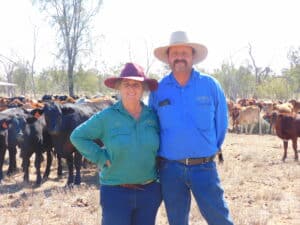
We are David and Lynette Keene and we run Northdown Cattle Company with our daughters, Ellen and Breanna. Our family business spans three properties in Central Queensland – Northdown near Emerald, Garden Creek near Springsure and Mafeking near Jericho – covering a combined 10,800 ha.
Our main aim is to breed cattle through to feeder weight, along with some trading. We have a red Brahman base and adjust our breeds to suit our country and where the market is heading. Over the years we’ve used Poll Hereford and Shorthorn genetics and we’re now introducing Angus as the market moves in that direction. We still retain our Brahman base, particularly for the brittle country on Mafeking where cattle need to handle longer distances to water.
David and I started our business from scratch around 25 years ago with one acre and 23 head of cattle. Since then, we’ve always been interested in learning, trying different things and finding new ideas on what works for our business.
FutureBeef is one of the places we use to find ideas. I read the eBulletin articles and share anything interesting with David and the girls. Quite often it starts a conversation such as “Did you see this?” or “Maybe we need to explore this a little bit more.”
Virtual fencing is a good example. We’ve used rotational grazing for many years and have seen the difference that putting larger mobs into smaller areas for shorter periods can make. On Mafeking, the size and scale mean it isn’t viable for us to install enough physical fences to achieve the cattle density and grazing pressure we’d like.
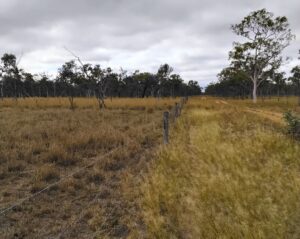
We first heard about the virtual fencing work underway at Spyglass through FutureBeef and went along to a demonstration day to see the technology in action. We later came across FutureBeef’s Virtual fencing for beef producers article, which triggered us to do more research into the different systems and what would best suit our operation.
We’ve now decided on a satellite-based virtual fencing system and are on the waitlist for its expected Australian release in February 2027. We already have the water infrastructure in place and plan to use virtual fencing to divide one existing paddock into around 60 grazing areas, with cattle moving daily over a 30-day rotation. Instead of grazing the whole paddock during their usual 30-day rotation, they’ll have access to a fresh grazing area each day, helping us achieve better grazing distribution while giving grazed areas time to rest. It’s a level of grazing control, animal monitoring and management that we couldn’t viably achieve there with permanent fencing. For us, it shows how FutureBeef can introduce or build on an idea that we can then see in practice, investigate further and work out whether it fits our business.
Pimelea toxicity is another long-standing issue on Mafeking. We’ve had significant problems in the past, including one year when we lost more than 80 cattle. These days we might still see around 10 to 20 cattle affected in a season, but we haven’t lost one for years. Since that major loss, we’ve developed our own approach to managing the risk while continuing to follow research into different management options.
Our replacement heifers receive biochar and molasses every two weeks from our custom-built lick trailer, which moves with the cattle as we rotationally graze. With our larger breeder mob, we keep a close eye on them and provide the biochar mix when needed, such as when we see signs of pimelea toxicity.
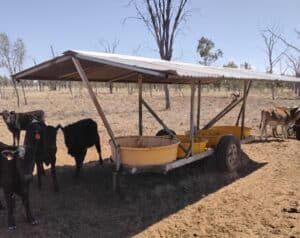
Over the years, we’ve followed FutureBeef pimelea information and research updates, including work looking at biochar and other approaches to managing toxicity. When earlier research hadn’t found all the answers, we thought the work might simply be parked. So when I saw the article about the new Novel options to manage pimelea toxicity in cattle project, I was excited to see the research was continuing.
We’ve also found that people don’t always realise how widespread the problem is around Jericho. Over the years we’ve spoken with other producers dealing with pimelea, including one grazier who had lost hundreds of cattle over the years and recently contacted us to ask what we’d been doing. We’re only one business and what works for us won’t necessarily suit everyone, but we’re happy to share what we’ve learnt.
I contacted the pimelea research team at DPI and we’ve now agreed to be involved in the producer survey as well as join the project board. It gives us an opportunity to contribute a producer perspective and continue learning as the research progresses.
That’s generally how we approach new ideas. We don’t take everything we read and follow it exactly. We pick out the parts that might suit our business, ask questions, try things and build our own plan from there. Just because something has always been done a certain way doesn’t necessarily mean it’s the right way for us.
FutureBeef is one of the resources that helps us do that. For us, it’s about the knowledge, information and ideas, but also being able to see what other producers are doing and hear from real people about their experiences. It’s not people talking at you ,it’s information and ideas that we can explore further, ask questions about and work out whether they fit our own business.
