
The steps to successfully establish a new pasture are the same used for forage and grain crops. The first operation in the paddock is a ‘fallow’ which includes controlling competition, storing moisture and reducing the seed bank. A fallow is the process of removing the existing pasture (and or other vegetation) with the goal of storing moisture in the soil. Stored soil moisture prior to planting reduces the risk of germinated seedlings dying if follow-up rainfall is not received soon after planting. A fallow has the added benefit of reducing the seedbank of weeds that will compete with a germinating pasture.
A fallow can be achieved through either spraying out the old pasture with herbicide, cultivating the paddock to kill the old pasture and break up the soil, or a combination of both. This article focuses on herbicide fallows including the advantages, risks, equipment and chemicals to consider. For more information on cultivation (tillage) equipment for fallowing, check out this page.
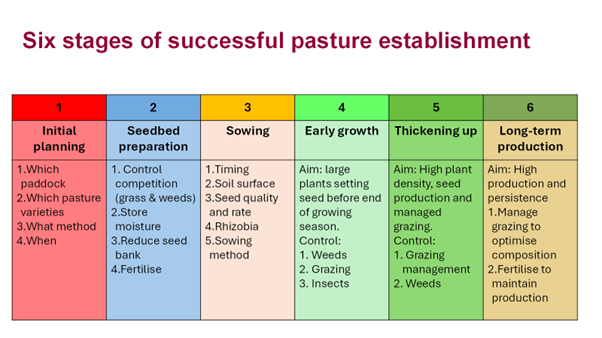
Fallowing is the collective term for the first three points under Step 2 – Seedbed preparation – in the six-step guide to successfully establish pastures, as shown below.
The investment in a fallow that stores moisture, and controls weeds greatly increases the success of pasture establishment and achieves production sooner.
Read about a grazier that successfully established desmanthus into fallowed strips with stored moisture at Toowoomba in the 2025/26 summer which was very dry.
To spray or cultivate?
Cultivation fallows can be effective on hard-setting soils that need to be broken up to achieve a suitable seedbed for germination, whilst herbicide fallows can be a faster more effective option on self-mulching soils that already have a natural seedbed. Alternatively, using a herbicide fallow to maintain organic matter on top of the soil can improve the structure of hard setting soils, so a combination of cultivation and herbicide can be useful on difficult soils. A strategic combination of cultivation and herbicide may provide the best fallow and seedbed preparation option for hard setting soils.
Maintaining a layer of dead grass mulch on the soil surface also improves rainfall infiltration and reduces evaporation, which stores more moisture. However, where there’s a very thick layer of dead grass mulch, seed-soil contact may be difficult to achieve meaning a direct drill planter (that cuts through the mulch and places the seed on the surface or just under) may be needed at sowing. Smaller and finer mulch layers can have seed spread on top and pressed into the soil with a roller.
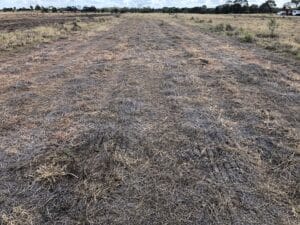
Seasonal conditions can impact the choice of fallow operation. Herbicide sprays that are taken up by the plant through green plant material (leaf and stems), which are the most common chemicals used for a spray fallow, should be applied to actively growing plants. This means the timing of spraying is restricted to after a rain event when there is green growing plants, whereas cultivation can happen at any time.
Applying herbicide is generally faster than cultivation. The work rate (hectares per hour) of ground spray rigs or booms sprays in buggies or utes, or aerial options like planes or drones, are much faster than tractors or dozers pulling heavy tillage equipment. Chemicals can be expensive, but generally spray operations are cheaper per hectare than cultivation.
In many cases, cultivation and herbicides are used together in a fallow. For example, on a hard setting soil, a couple of fallow operations using herbicide can be used to kill the old pasture while keeping a mulch layer for the infiltration and organic matter benefits, but the last operation could be a cultivation to prepare the seedbed and reduce the mulch layer for seed-soil contact at sowing. On a heavier clay soil, several cultivations might be used to break up clumping and clods and once a good seed bed has been achieved, herbicide can be used to control weeds prior to planting.
Spray equipment
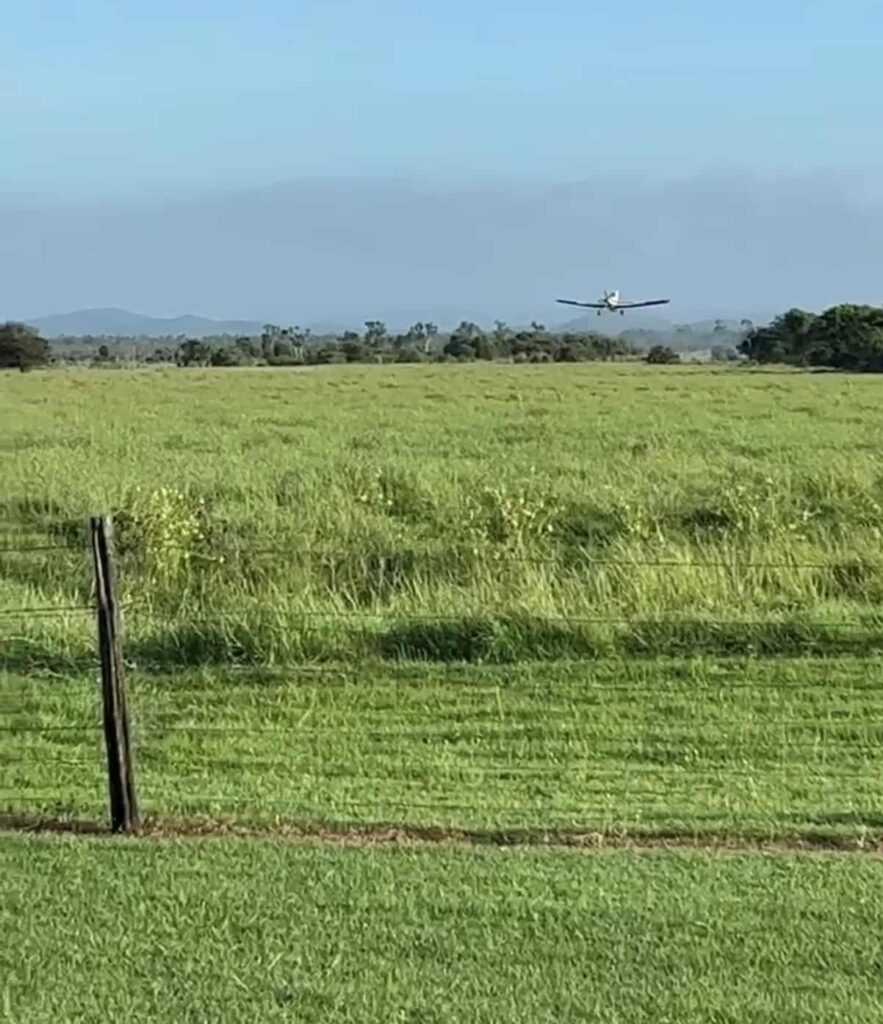
Herbicide can be applied by ground rigs or from the air. Ground spray rigs can be more appropriate when planting a smaller paddock, or when preparing strips to sow legumes into an existing grass pasture. Aerial application of herbicide is more practical for larger areas, or for country that is difficult to get across on the ground i.e. has a lot of fallen timber, rocks, suckers or melonholes.
Ground spray rigs
Ground spray rigs are towed or driven across the ground. Smaller versions can be towed behind buggies, ATVs or utes, whilst larger types are towed (‘trail behind’) or mounted on the three-point linkage of tractors. Self-propelled sprayers are commonly used in broad acre farming. Ground spray rigs have a purpose-built tank, pump, boom and nozzles and need to be set up for the specific situation – pressure, nozzle type, and speed all impact application rate. Also, an ability to handle undulations, a break-away system on the boom to prevent damage if it hits a firm object, and markers or GPS guidance, are all beneficial features.
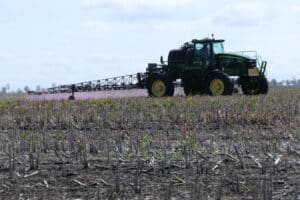
Boom sprays mounted on buggies or utes
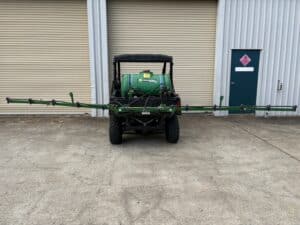
A common option for graziers who don’t have the need for a large ground rig is to use boom sprays mounted on buggies or utes. These come in various set ups with different size tanks and width booms. Most use a 12V pump and can be wired into switches on a dashboard inside the vehicle for easy operation. Pressure can be adjusted to ensure the correct application rate and the speed of the vehicle needs to be monitored so application rate is consistent and good coverage is achieved.
Nozzles
When spraying herbicide through a boom spray it is important to consider the height of the nozzles, the types nozzles that are being used, the pressure generated by the pump, and the speed at which the boom spray is travelling. It is recommended the nozzles be set to spray 50cm above the target plant to ensure proper chemical application overlap between the spray nozzles.
Nozzles control the droplet size, spray pattern, and flow rate. Droplet size determines how the spray behaves. Smaller droplets provide better coverage but are more susceptible to drift. Large droplets reduce drift but offer less coverage. Spray pattern is impacted by the tip inside the nozzle. The types can include a flat fan, cone, or stream style. For most pasture applications a flat fan spray type is used. Flow rate determines how much fluid passes though the nozzle at a given pressure, and this combined with the speed at which the equipment travels across the paddock determines the application rate per hectare. It is important to have spray gear calibrated for the chemical being applied in each situation.
Tank size
The size of the tank and application rate of chemical will dictate how often a tank will need to be refilled on a spray job. If spraying a large area, consider how large the tank needs to be (and if the machinery carrying or towing the tank can handle the weight) or the best method of refilling the tank to avoid long trips out of the paddock. Having a ‘service’ vehicle in the paddock with a tank or pod of water and drums of chemical can be a good option to save time.
Planes, helicopters or drones
For most graziers, aerial application of herbicide is done by a contractor, unless a plane/helicopter/drone is owned. When engaging a contractor, chemical and water is usually delivered to the airstrip or place where the aircraft will refill. Only engage with experienced operators who are fully licenced and insured.
Chemicals
Chemicals for herbicide fallows vary widely depending on what the target plant is, e.g. grasses, broadleaf plants or both. Note that only chemicals registered for the target plant(s) in a specific situation should be used. Generally, Glyphosate works effectively for grasses whereas in pastures that also contain broadleaf weeds, additional herbicides may need to be used. Seek advice from an experienced agronomist on specific herbicides and rates for the situation. Information on mixing, water dilution rates, wetter requirement and per hectare application rates for various application methods i.e. spot spray vs boom spray vs aeroplane are found on herbicide labels.
Always follow the directions on the label to make sure you meet WHS requirements.
Important considerations to get it right
Record keeping
Its highly advisable, and required for some herbicides, for the spray operator to record what chemicals were applied at what rate, and the weather conditions (wind speed and direction, temperature, humidity) at the time of application. Always follow the on-label requirements for all chemicals applied.
Weather
Wind is the obvious weather condition that will affect herbicide use, so choosing a safe time to spray is paramount. Most broad acre farmers spray early in the morning when wind speed is lower, temperatures cooler and humidity higher, and there will be several hours of sunshine for active plant growth for rapid translocation of the herbicide applied.
Spray pattern
It is recommended to use a GPS or an effective marker system to ensure full coverage is achieved across an area. Guessing spray runs across a paddock will inevitably result in missed patches when overlap is too large or wasted chemical when applying to areas already sprayed.
Written by Hayden Houweling, Kylie Hopkins and Stuart Buck from Rockhampton DPI as part of the Queensland Pasture Resilience Program which is a partnership between the Department of Primary Industries, Meat & Livestock Australia and the Australian Government through the MLA Donor Company.
