
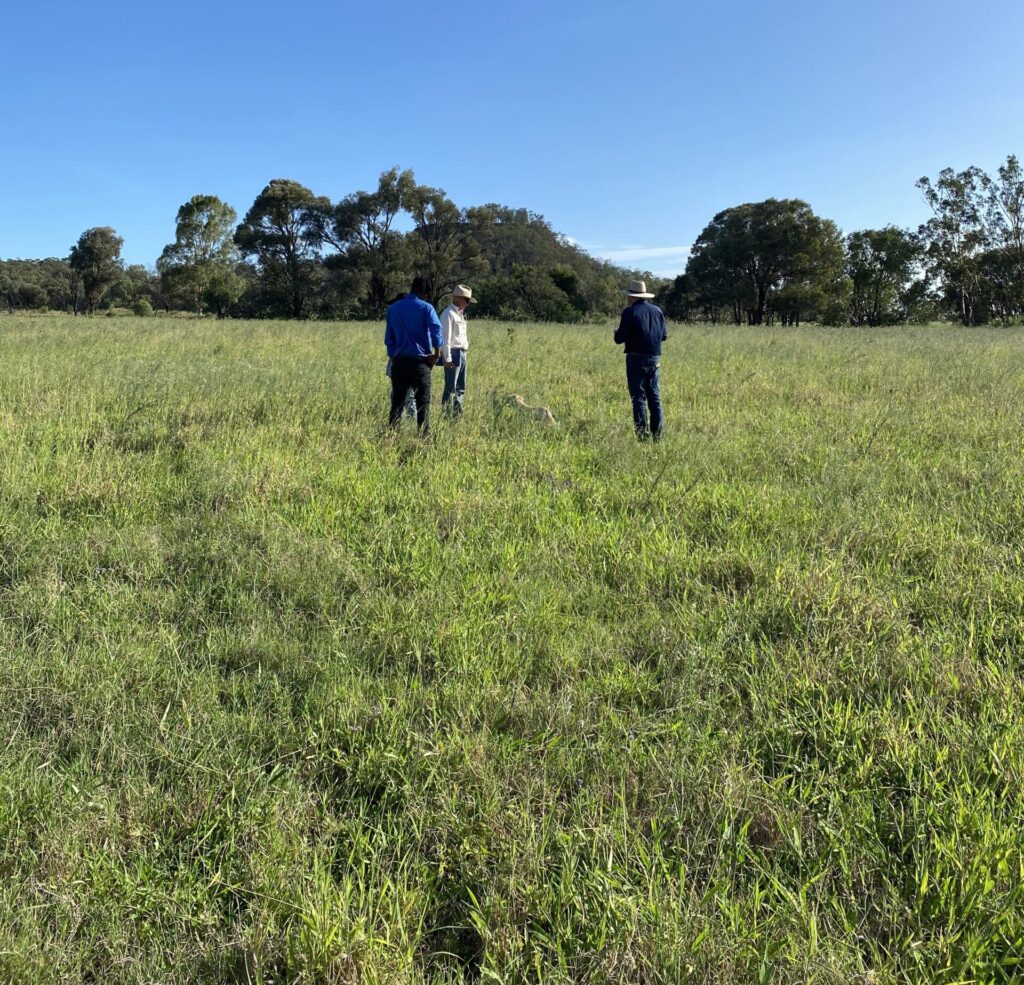
With good recent rainfall and ideal temperatures across the state, one would reasonably expect pastures to respond well. However, that’s not always the case, particularly on many improved pasture paddocks. As these improved pastures struggle to respond over time, tussocks become smaller, produce less seed and eventually composition in the paddock starts to change. What was once a beautiful buffel pasture can become dominated by undesirable species like Indian couch. Pair that with over grazing and this change can happen within a few seasons.
“It just doesn’t bounce back like it used to.”
This is a phrase tossed around which is often followed by the comment that the “country is pretty tight.” And whilst it’s a fair assumption that poor response after rain can be a water infiltration issue, that’s generally not the case in improved pasture situations.
Pasture rundown
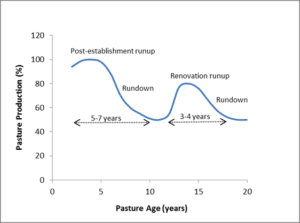
The real issue in most cases is soil nutrient supply. Many of our introduced pasture species like buffel are very productive and therefore have high nutrient demands relative to our native pasture species. Their growth is commonly limited by the nutrients in the soil – mainly nitrogen (N). When improved grass pastures have low N supply and not reaching their productive potential we call this pasture rundown. This condition allows species with low nutrient requirements like Indian couch to get a foot hold in a paddock and out-compete better grasses.
Pasture rundown has been well documented and researched across northern Australia and you can read more about it in these 3 factsheets.
- Sown pasture rundown 1: The productivity decline of sown pastures over time
- Sown pasture rundown 2: Strategies to increase nitrogen inputs
- Sown pasture rundown 3: Strategies to increase nitrogen cycling
To save you some reading though, here’s the highlights reel of the nitrogen cycle in pastures.
Where did the N go?
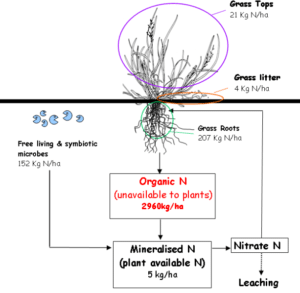
N exists in the soil in two forms; mineralised and organic N. Mineralised N (e.g. nitrate-N) is plant available and readily taken up by plants but it’s also used by microbes to break down organic N. In effect, the microbes and plants are competing for the same mineralised N as a food source.
Organic N is in soil organic matter (e.g. old leaves, stems, roots, and manure) and so is not directly accessible to plants. Organic N needs to be broken down (mineralised) by soil microbes to become plant-available again.
If the microbes don’t have enough mineralised N, they can’t break down the organic N to produce more mineralised N. They need it…and they also help produce it!
This is why we say N is ‘tied up’ in soil organic matter. In systems with improved pastures that have high N requirements, the microbes simply can’t keep up mineralising N, so the grass effectively becomes N deficient.
The process of N changing from pools of mineralised N to organic N is called N cycling.
Poor water infiltration is often blamed for low pasture response after rain because common ways to increase infiltration also increase mineralisation of N. Yes, mechanical disturbance such as ripping, blade ploughing, or offsetting, open the soil up for rain, but the plant response is mostly from the increased supply of mineralised N ready for plants and microbes to use. The mechanical disturbance kills vegetation which starts to decompose, which mineralises N. This process is referred to as ‘mechanical renovation’ and can be very effective to mineralise N from organic matter, but whether it’s the optimal solution in the long term is another question.
Deep ripping can be a useful tool for reducing compaction from livestock, machinery, or water logging. Consider though, if the soil has a compaction issue or if they are naturally hard setting. A lack of ground cover and organic matter can exacerbate surface sealing on hard-setting soils. Deep ripping won’t change the soil texture and can lead to other issues particularly if soil from a sodic B horizon is brought to the surface, leaving you with more problems than what you started with. When it comes to managing hard setting soils, organic matter is your friend.
Increasing N supply
There are three options available to increase N supply in pastures.
| Option | How N supply is increased |
|---|---|
| 1. Mechanical renovation (e.g. blade plough, off-setting, deep ripping) | Mineralising N tied up in soil organic matter |
| 2. Applying fertiliser or another product with N | Adds more N |
| 3. Introducing annual or perennial legumes | Adds more N |
Each of these strategies come with their pros and cons and need to be considered based on individual business needs.
1. Mechanical renovation
Using mechanical renovation can increase N cycling from soil organic matter, but its effectiveness is limited by the method used (more disturbance the better), seasonal conditions (wetter the better), and the amount of N tied up in organic matter (more the better). Unfortunately, while mechanical renovation will boost pasture productivity, the response will only last for a few years before returning to a rundown state. This is because the grass that regrows quickly takes up the mineralised N and this is locked back up into plant organic matter (roots and shoots).
Deep ripping
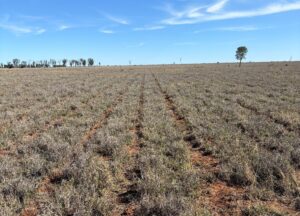
Single pass ripping is a common method used and an effective way to open the soil in defined zones and mineralise N. However, benefits are limited to the grasses near the ripped area and are short lived.
Blade plough, cutter bar, and offsets
Full paddock renovation using blade ploughs or cutter bars are better at increasing N cycling relative to ripping as all grass is killed. It’s a nice bonus that comes with regrowth control operations. However, it’s more costly and recovery relies on seedbank populations of good grasses and rainfall. Excessive blade ploughing can also cause hard pans below the topsoil which can impact water and root infiltration into the sub soil.
Things to consider with mechanical renovation
Before you jump on machinery and charge through the paddock, there are a few considerations to make. The benefits of renovation rely heavily on the amount of organic matter available to be mineralised, and the rainfall to make it happen. In low pasture-production country and low rainfall environments it could end up being a negative return on investment. Erosion risk is also a huge factor to consider with any soil disturbance when ground cover is reduced.
Say it with me: blade ploughs are for regrowth and renovation, NOT preparing a seedbed for small-seeded legumes! Throwing out seed (e.g. desmanthus, stylos) behind a blade plough is a sure-fire way to waste money. The soil is left very rough and full of large cracks for tiny seeds to fall down never to be seen again. If you’re considering planting a pasture after regrowth control paddocks will need more cultivation operations to create an ideal seedbed.
Check out the pasture establishment factsheet and other articles on seedbed prep and cultivation machinery options.
2. Fertiliser
Fertilising is one way N can be added to the soil. Depending on how and when it is applied, pastures can respond rapidly and increase in quantity and quality. Using fertiliser means that the amount of N applied can be controlled based on what the soil requirements are. Getting a soil test can help determine how much should be applied and if any other nutrients are lacking. The ease of tailoring fertilising to the situation means it’s on the lower end of the risk scale compared to renovation or pasture establishment… but not foolproof! Like renovation, the results only last a few years depending on how much N is applied and good rainfall is still needed to maximise benefits. Consider the current soil fertility and predicted rainfall before calling your local fertiliser supplier. N fertiliser is also pricey, comes with application costs every few years, and specific products (e.g. urea) need rain for incorporation soon after application to be effective.
3. Legumes
Two birds, I’d like to introduce you to our one stone for pasture rundown! Legumes in the right population density that have effective nodules will increase plant available N in the soil. Legumes can be established in existing pastures in a few different ways. If there’s still a reasonable population of desirable grass species, then legumes could be planted in strips or zones across the paddock. However, if the paddock is dominated by undesirable species like Indian Couch, then a fence-to-fence approach with a new grass/legume mix is needed. To realise the benefits of N cycling and livestock performance from legumes, there needs to be a significant population throughout the paddock. A good rule of thumb is 25-30% of the total biomass at a minimum. Most species will have a positive impact on pasture quality and production at a lower percentage, but when we’re talking legumes: more is more! Legumes also need to be inoculated with the appropriate rhizobium at planting for root nodulation and N fixation. Bacteria in the nodules fix atmospheric N from the air in the soil and supply N to the legume. The N-rich legume tissue is eaten by cattle who drop manure and parts of the plant are broken off and returned to the soil. This N-rich organic matter is then broken down by microbes into mineralised N.
Establishing pastures have a high upfront cost and can be risky. Good paddock preparation and pasture establishment practices can help reduce the risk, but seasonal conditions still play a significant role. For best practice guide to establishing a new pasture check out this factsheet or contact your local DPI Pastures team member.
Despite large upfront costs, legumes are the most economical long-term solution for pastures affected by rundown. If effectively established and managed appropriately through grazing and nutrient supply, legumes can persist for decades.
Economics
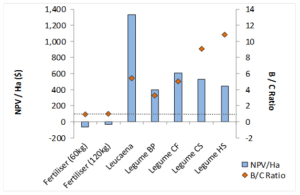
So how do the costs stack up? Economic comparisons for adding N to rundown systems showed that over a 30 year period, perennial legumes were by far the most cost effective. Application of low (60kg/ha) or high (120kg/ha) rates of N applied annually ran at a loss despite fertiliser potentially growing more pasture.
Pasture rundown is a common and widespread issue that producers are facing in improved pasture systems. The good news is there’s options out there to help reverse production decline. If you’re unsure what method to use or how best to implement it, contact your local DPI Pastures team member who can help tailor strategies to your business.
Written by Dana Walkington from Emerald DPI, as part of the Queensland Pasture Resilience Program which is a partnership between the Department of Primary Industries, Meat & Livestock Australia and the Australian Government through the MLA Donor Company.
