
Pasture dieback is a condition that causes the premature death of tropical and sub-tropical grasses. Improved (or sown) grass species are mainly affected however some native species have also been reported, whereas broadleaf plants (e.g. weeds or legumes) are unaffected.
In this article, we discuss:
Identification and cause of pasture dieback
DPI and MLA co-funded pasture dieback projects
Conference papers on the issue
Queensland Pasture Resilience Program
Prefer to watch rather than read? We’ve got videos
Rather listen than watch? Here’s our podcast episode
Pasture dieback distribution
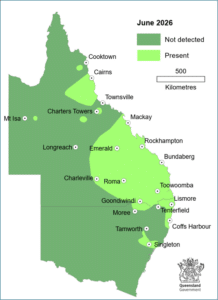
Pasture dieback affects grass pastures in eastern areas of Queensland, and north-eastern New South Wales, generally in regions that receive more than 600 mm average rainfall (see map below). The death of grasses initially appears in patches but can spread to large areas and whole paddocks within one growing season. The first symptoms include leaf discolouration (reddening and or yellowing) and unthrifty growth. Once dead, the affected area is commonly colonised by broad leaf weeds or legumes. Recent research has demonstrated several successful management options for paddocks affected by pasture dieback.
Identification and cause
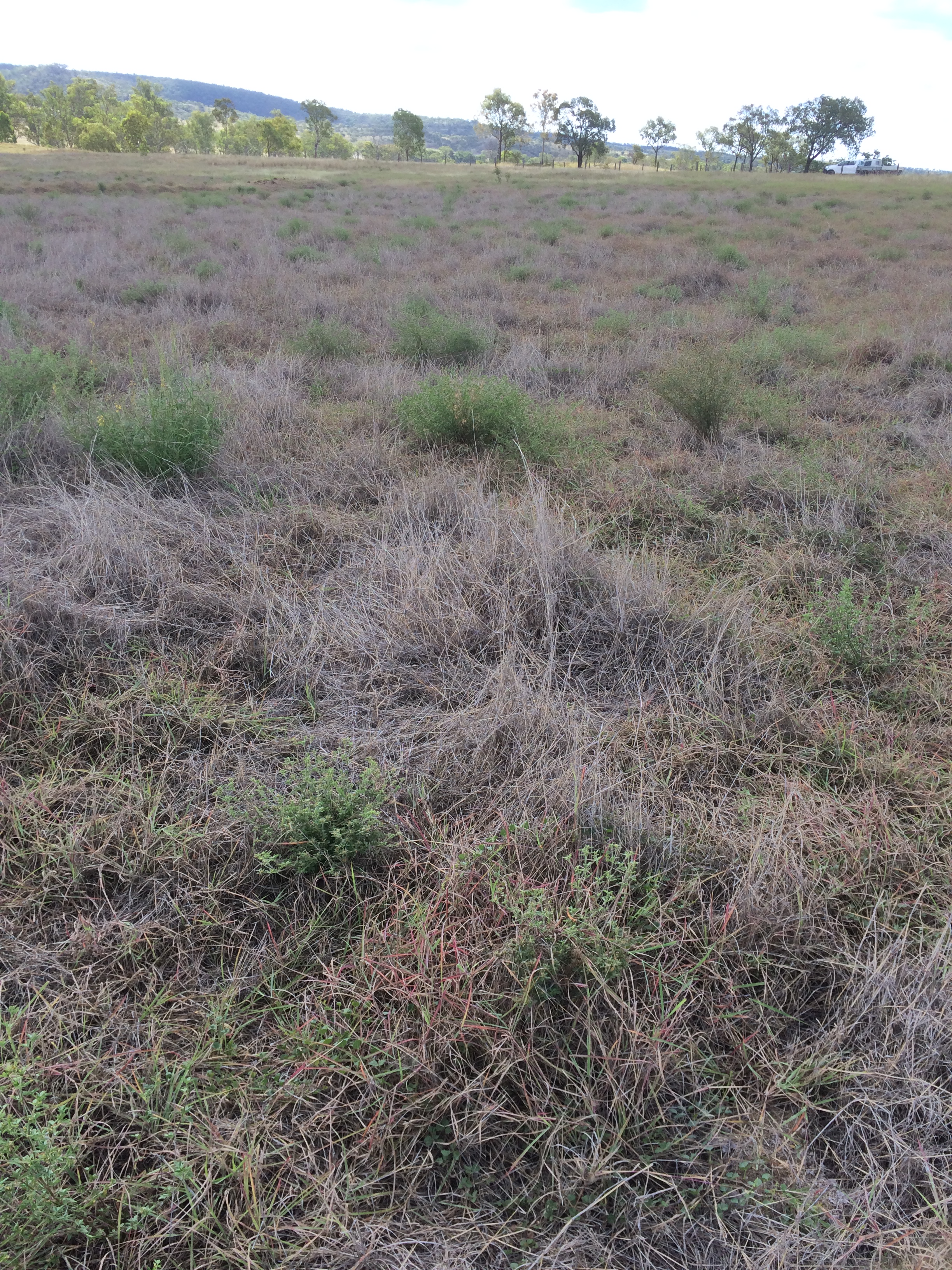
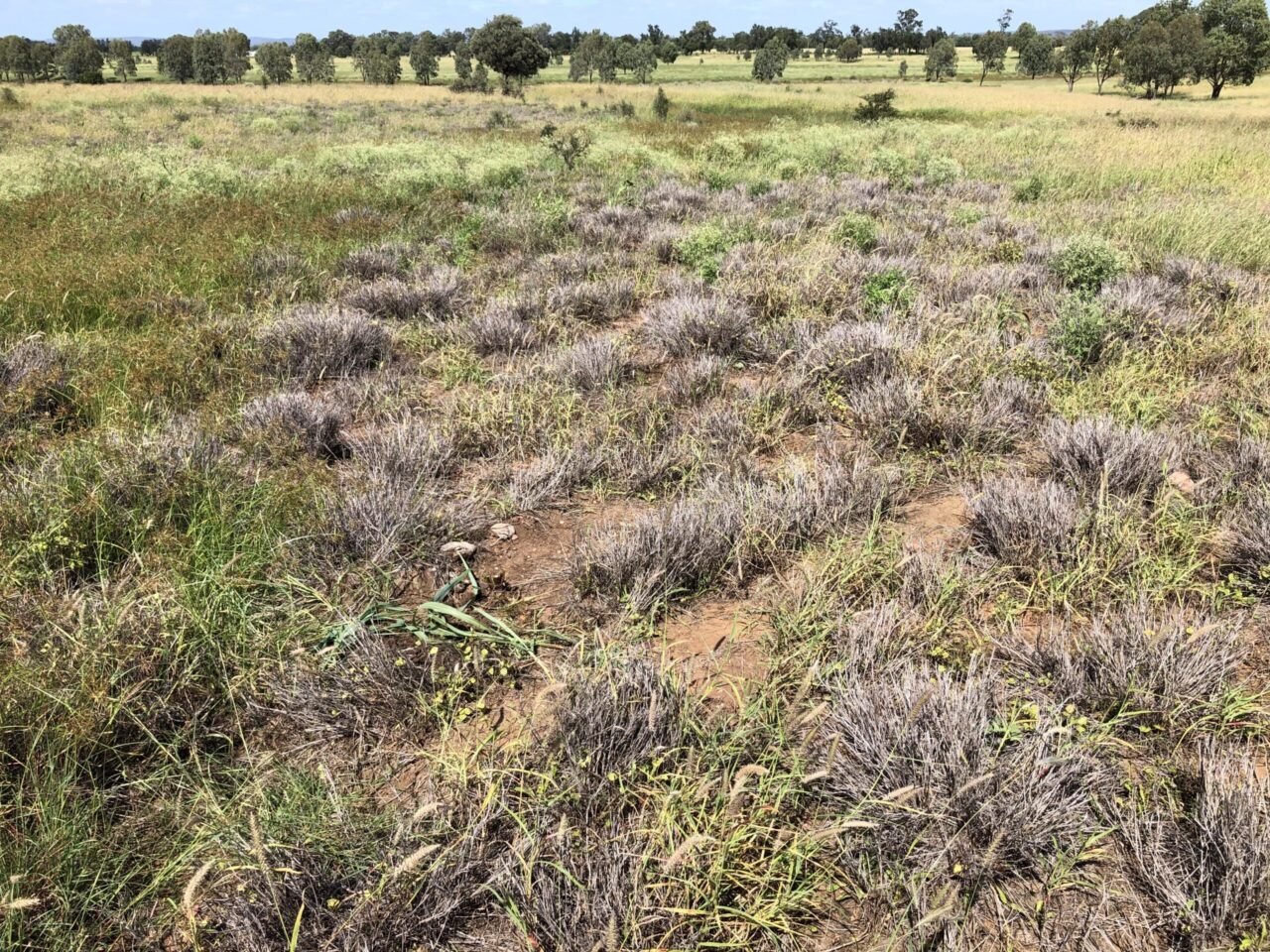
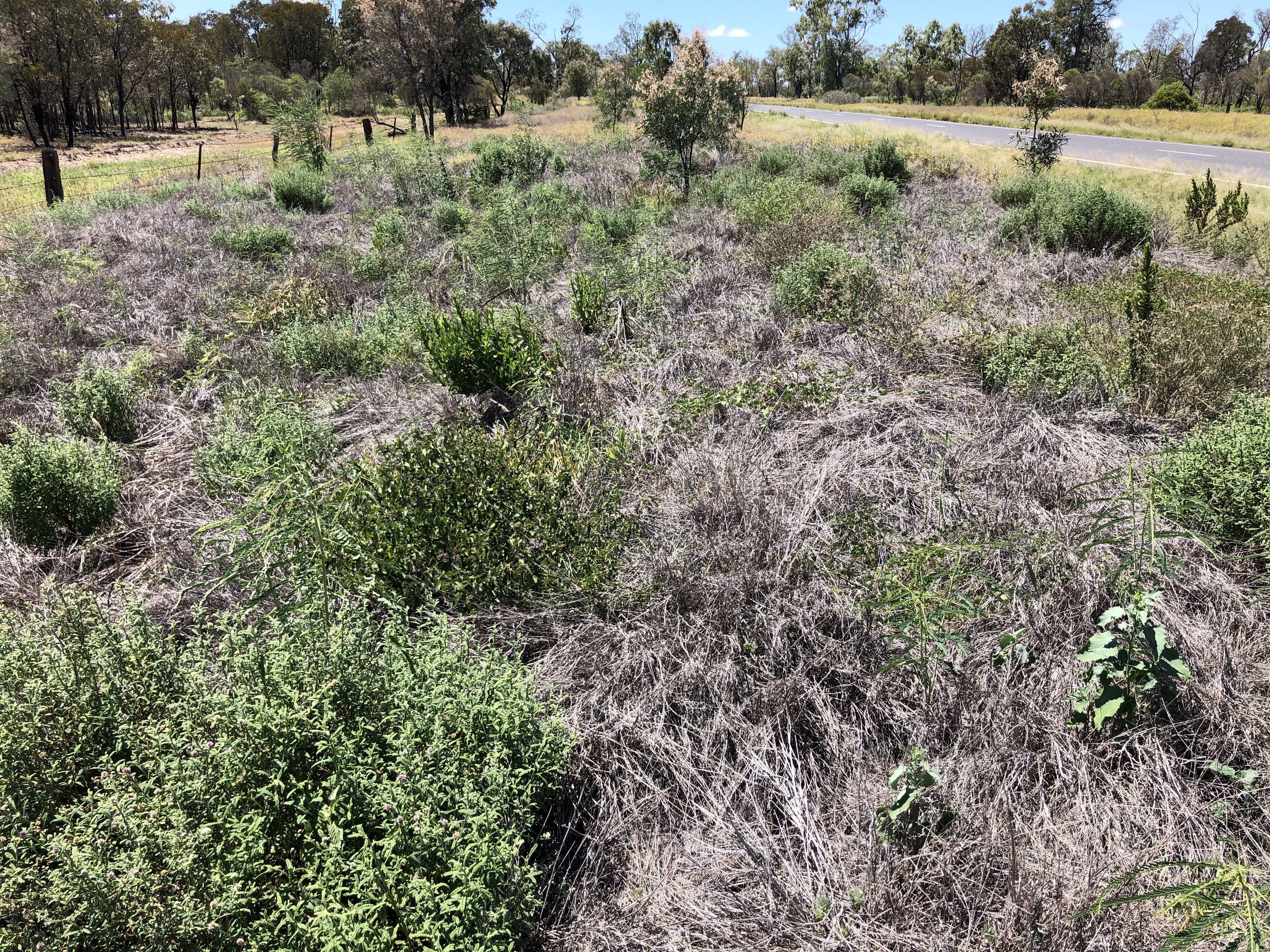
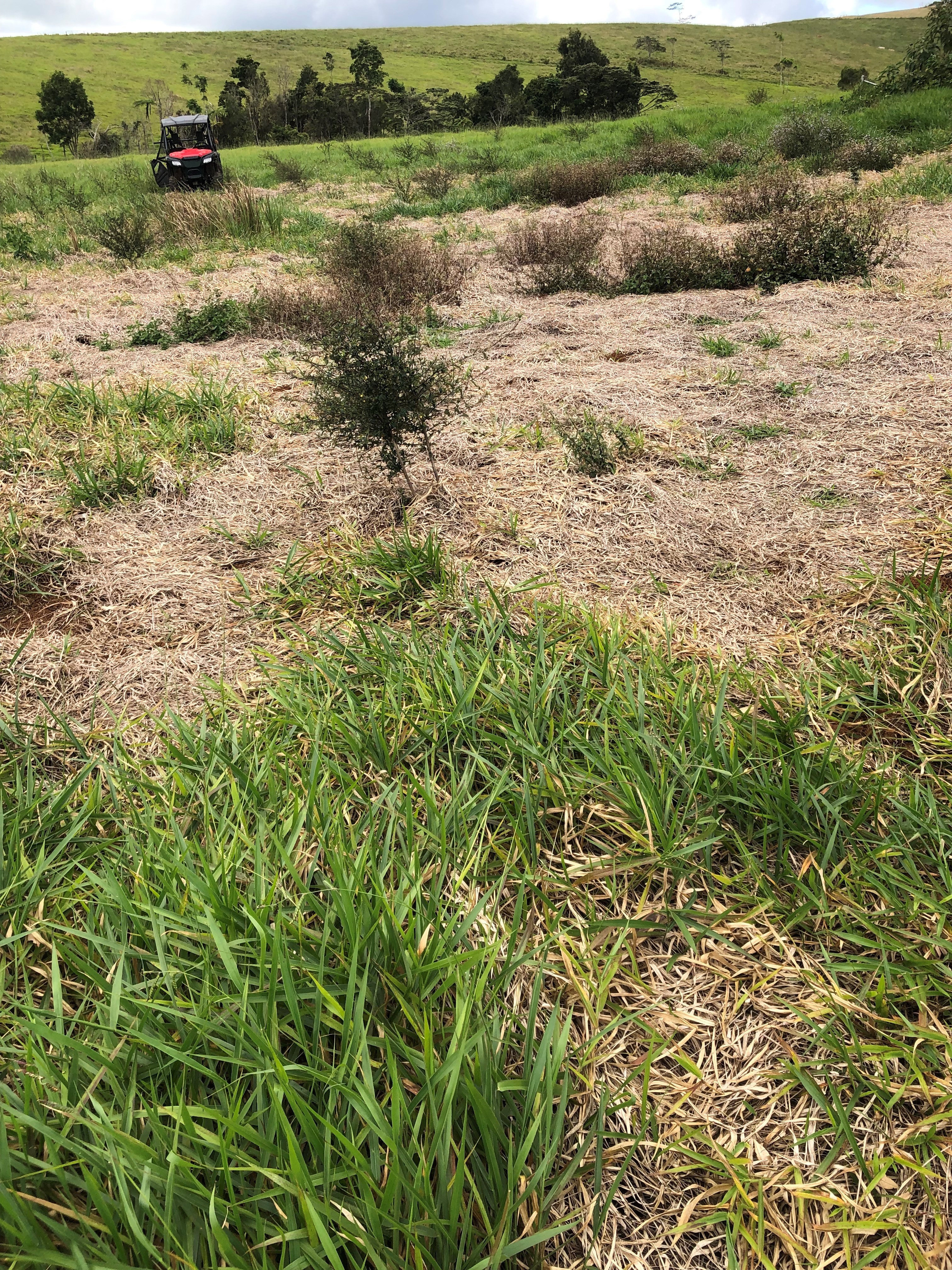
Pastures are initially affected in patches and exhibit leaf reddening, yellowing, or both. As the condition progresses, poor growth, early senescence, and eventual death occur. Depending on rainfall, this process can occur quickly within one summer season. With subsequent rainfall, broadleaf weeds and or legumes commonly colonise the affect area (as seen in photos above). For reliable diagnosis other potential causes of the observed symptoms need to be ruled out.
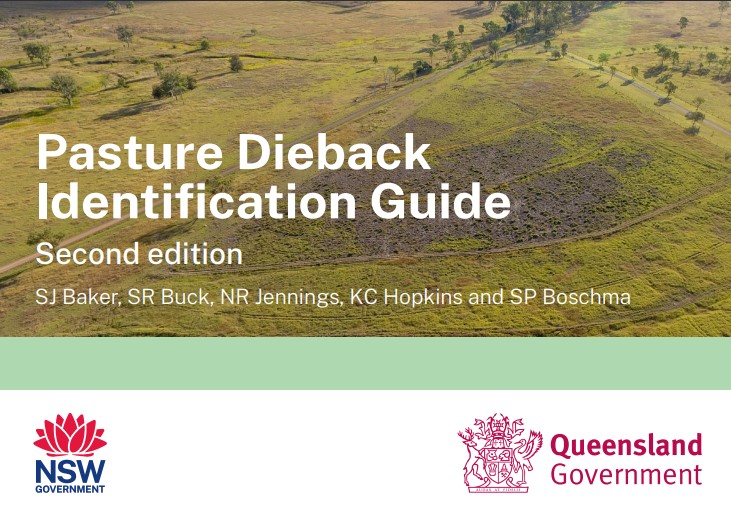
For more help on identifying pasture dieback, use this Pasture Dieback ID guide 2nd edition produced by NSW DPIRD, NSW LLS and QLD DPI, read this article about pasture dieback signs and symptoms or watch this video.
If you see symptoms of pasture dieback (stressed tropical grass species with yellowing and reddening leaves), you might be able to find pasture mealybugs too. Pasture mealybugs (Heliococcus summervillei) are sap-sucking insects and they are currently the leading cause of pasture dieback.
They are tiny insects – juveniles that do the feeding that causes damage are about 1-2mm in size. Adult females can be up to 5mm, white or pink and ‘fluffy’ looking as they are covered in a waxy coat of filaments. Adult males are very small like juveniles but have wings and are rarely seen. This video shows juveniles and females feeding on a leaf of Bisset creeping bluegrass. Pasture mealybugs have natural predators such as ladybirds, lacewings and Chalcid wasp.
Management options
Recent research conducted by the Department of Primary Industries team has demonstrated successful management options are available to restore pasture productivity.
Click here to read the LATEST Management of pasture dieback factsheet.
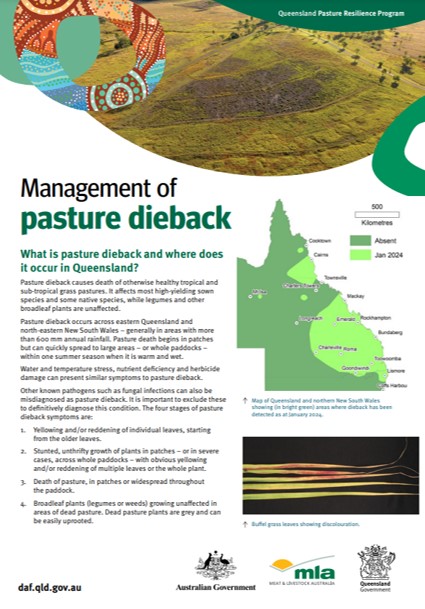
Read this fact sheet on choosing grass varieties tolerant to pasture dieback produced by Meat & Livestock Australia (MLA).
Watch the videos below for Pasture Dieback Management options.
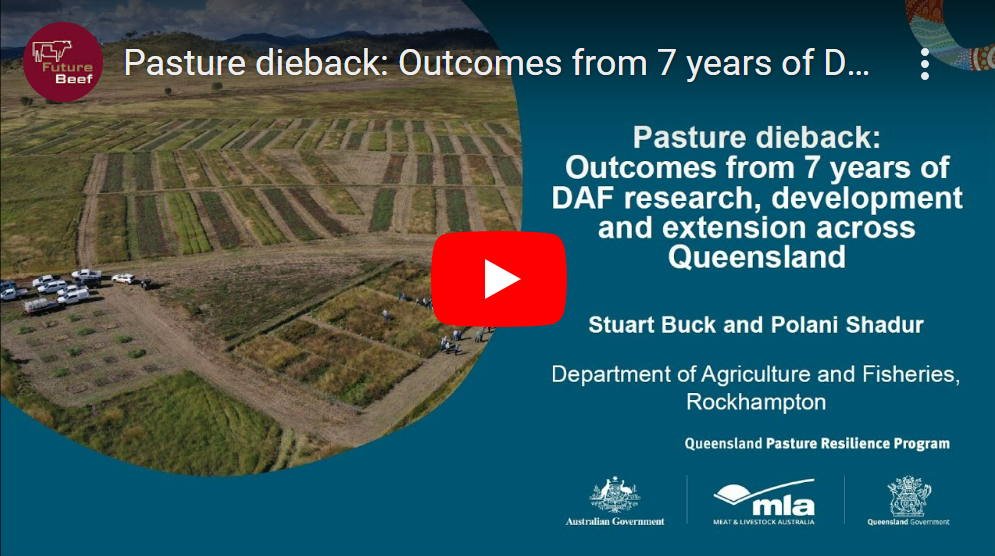
View the latest webinar on Pasture Dieback: Outcomes from 7 years of DPI research, development and extension across Queensland.
Producer case studies – managing dieback
Click here to read about how a producer in Central QLD has been managing Pasture Dieback.
Owen Price from the Arcadia Valley shares his family’s experience in first discovering they has pasture dieback and understanding the huge production losses it was causing. He speaks through what they tried that didn’t work, before deciding to use dieback as an opportunity to get legumes established into what was previously Gayndah and Biloela buffel country. Alongside Stuart Buck and Kylie Hopkins (Department of Primary Industries) they share their experiences helping graziers managing dieback.
Cyril and Cody Close share their experience on their Roma property, alongside Ted Callanan (Department of Primary Industries), as they relay practical insights into the rapid impact of dieback and how affected paddocks are being managed. The Close family openly share what they tried, what worked, what didn’t, and how their management has changed as they rebuild pastures and confidence.
Warren Luhrs at Moura speaks about how he identified his pastures were underperforming due to pasture rundown and pasture dieback and what he has decided to do about it. Alongside Stuart Buck (Department of Primary Industries) they speak about the process of planting a new pasture to ensure the best success.
Report pasture dieback
Want to help us understand dieback better? Use our free app to report pasture dieback.
Industry updates
September 2026 – Pasture dieback update: Spring 2026
December 2025 – Drones opening new doors for pasture recovery on difficult country
September 2025 – Beyond Kikuyu grass: What’s next and the opportunities
June 2025 – Where to the bugs go? Pasture dieback over the winter
September 2024 – Spring opportunities for pasture dieback affected paddocks
June 2024 – Recent learnings from pasture dieback research sites
March 2024 – Pasture dieback detected in new areas of Queensland
February 2023 – Keep an eye out for pasture dieback
March 2022 – Pasture dieback update
April 2021 – Darling Downs – Pasture dieback watch!
May 2020 – Pasture dieback in Qld (webinar delivered with NSW DPI)
April 2020 – Rigorous research to determine pasture dieback causal agent
February 2019 – Latest insights into pasture dieback (webinar)
May 2017 – Pasture dieback situation report
Event summaries
- 2025 field days in the South – information days at Tannymorel and Yarraman
- 2024 field days in the South – key messages from Condamine, Goondiwindi and Dulacca
- 2024 info days in the South West – key messages from Mitchell, Augathella and Blackall
- 2024 field day at Boonah – Species tolerance to pasture mealybugs
- 2023 field day at Boonah – Mealybugs and viruses at pasture dieback trial
- 2023 field days at Wonga, Moura and Gundabah, Middlemount
- 2021 field day at Brian Pastures, Gayndah
Conference papers
| Conference | Publication | Author |
|---|---|---|
| 33rd Pastures & Grazing NSW Conference, Tamworth NSW, 28-30 July 2026 | Pasture Dieback — is this an issue for the North West (of NSW)? | Ted Callanan, Gavin Peck and Stuart Buck |
| International Rangelands Congress, Adelaide SA, 2-6 June 2025 | 2025 situational analysis of pasture dieback in eastern Australia | Stuart Buck, Polani Shadur and Kylie Hopkins |
| Northern Beef Research Update Conference, Darwin NT, 22-25 August 2023 | Effective management options for pasture dieback | Stuart Buck, Polani Shadur, Paul Jones, and Kylie Hopkins |
| Northern Beef Research Update Conference, Darwin NT, 22-25 August 2023 | Assessing pasture dieback with a drone | Polani Shadur, Stuart Buck, Kylie Hopkins, and Paul Jones |
| Northern Beef Research Update Conference, Darwin NT, 22-25 August 2023 | Pasture development using the Action Learning Cycle: A case study | Kylie Hopkins, Polani Shadur, Paul Jones, and Stuart Buck |
| 20th Australian Agronomy Conference, Toowoomba QLD, 18-22 September 2022 | Management solutions for pasture dieback: Outcomes of field research | Stuart Buck, Nicholas Brazier, and David Reid |
| 34th Australian Association of Animal Sciences Conference, Cairns QLD, 5-7 July 2022 | Targeted industry engagement was spot-on for pasture dieback | Kylie Hopkins, Nicholas Brazier, Katie Thomas, and Stuart Buck. |
| 33rd Biennial Conference of the Australian Association of Animal Sciences, Perth, WA, 1-3 February 2021 | The resurgence of pasture dieback in northern Australia | Stuart Buck, Nicholas Brazier, Terry Beutel, and Lara Landsberg |
| 33rd Biennial Conference of the Australian Association of Animal Sciences, Perth, WA, 1-3 February 2021 | Characterising pasture dieback: Analysis of the current situation in northern Australia | Nicholas Brazier and Stuart Buck |
| Northern Beef Research Update Conference, Brisbane QLD, 19-22 August 2019 | The re-emergence of dieback in pastures across Queensland | Stuart Buck |
DPI and MLA’s co-funded Pasture Dieback projects
Between 2020 and 2022 DPI and MLA delivered two co-funded projects addressing pasture dieback. The first was aimed at diagnosing the cause and the other aimed to help producers identify and manage the condition. Read more the final reports from these projects for more details:
Final report: Comprehensive diagnostic analysis of pastures affected by dieback
Final report: Grazier engagement to increase knowledge, skills and ability to combat pasture dieback
Trial site summaries
A summary of the trial design, treatments and key learnings for each pasture dieback trial site in CQ is summarised here.
| Year established | Location | Years of data |
|---|---|---|
| 2020 | Middlemount | 5 |
| 2020 | Biloela | 5 |
| 2020 | Banana | 5 |
| 2020 | Moura | 5 |
| 2018 | Brian Pastures | 7 |
Pasture Dieback Industry Network
The Pasture Dieback Industry Network (PDIN) was created in 2020 to help connect graziers and ag professionals to the latest DPI research and events. The network finished in 2022 however click here to read more about the PDIN and the previous e-newsletters sent to the group.
Queensland Pasture Resilience Program
If you are looking for more support to help manage country affected by pasture dieback, you might be interested in the Queensland Pasture Resilience Program, a partnership between DPI, Meat & Livestock Australia (MLA) and the Australian Government through the MLA Donor Company.
