Producer survey highlights buffalo fly control challenges and opportunities for tunnel traps
Buffalo flies remain a significant challenge for Queensland livestock producers, affecting animal welfare and productivity. To understand current management practices and the potential of buffalo fly tunnel traps, the Department of Primary Industries, with the support of FutureBeef and AgForce, conducted a survey between 2–15 December 2025. The survey attracted 177 responses and revealed critical insights into the challenges posed by buffalo flies and industry’s interest in alternative solutions. Thank you to everyone who completed the survey.
Buffalo flies: a persistent problem
The survey confirmed the widespread impact of buffalo flies, with 92.7% of respondents stating that they are a problem on their properties. This highlights the need for effective control measures to mitigate the economic and animal welfare consequences of buffalo fly infestations.

Current management practices
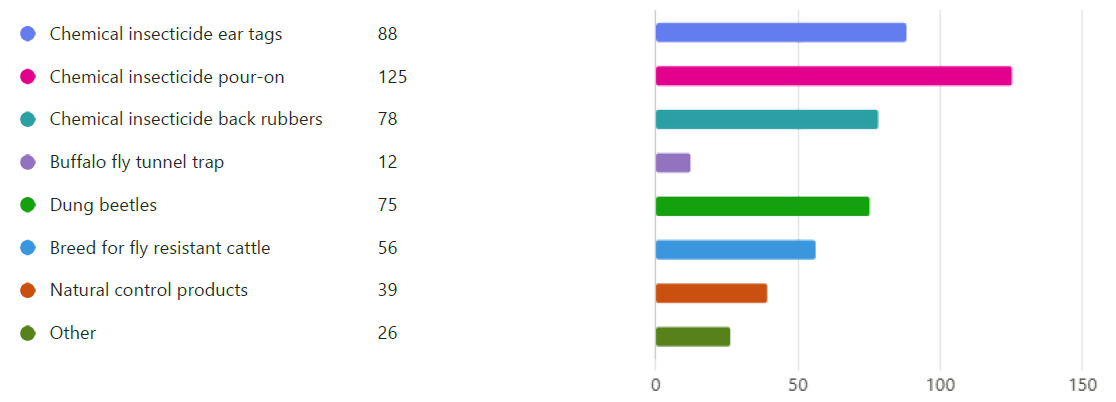
Chemical insecticides are the primary tool for managing buffalo flies, with 80% of respondents relying on products such as ear tags, pour-ons, and sprays. Among non-chemical approaches, dung beetles were the most used, with 42% of respondents employing them to help break the buffalo fly life cycle. Breeding cattle for natural resistance was another common strategy, used by 32% of respondents.
Buffalo fly tunnel traps are being used by 7% of participants, a figure similar to the use of backrubbers and double the number using mineral licks (falling under ‘other’ in the figure below). The traps have not been widely adopted by industry since their release in 2006.
Insecticide resistance: a growing concern
A key finding of the survey was that 56% of respondents observed a decline in the effectiveness of insecticides for controlling buffalo flies, signalling growing resistance among fly populations. Reports of reduced efficacy spanned chemicals in all three major chemical classes: organophosphates (OPs), synthetic pyrethroids (SPs), and macrocyclic lactones (MLs). Among the reported treatments, chlorfenvinphos (OP), permethrin (SP), and moxidectin (ML) actives were identified as the most affected.
Producers frequently noted shorter protection periods for insecticides rather than complete failure. Ear tags and pour-ons—two of the most common application methods—were the most likely to show reduced efficacy. In some cases, ear tags provided protection for only a few days to three weeks, especially during wet months with heavy rainfall. Seasonal factors, such as longer fly seasons and larger fly populations, further complicated efforts to control the pests.
Some producers expressed confusion about chemical group rotation and its importance in slowing resistance. Improved industry efforts to inform producers about chemical rotation could help preserve the efficacy of existing treatments.
Interest in buffalo fly tunnel traps
The survey revealed strong interest in buffalo fly tunnel traps, with over half of respondents expressing enthusiasm for trying them in the future. With only 7% of respondents currently using the traps, further questions were asked to ascertain what the key barriers to adoption might be.
Around 7% of respondents had never heard of tunnel traps. Others expressed uncertainty about their potential effectiveness.

Challenges and opportunities for improvement
Producers who had used buffalo fly tunnel traps provided valuable feedback on their experiences. Only three respondents reported trap failures after construction, and two of these were working on design modifications to improve them. Several respondents highlighted challenges in building the traps, particularly the cost and effort involved.
Path forward for buffalo fly management
The survey highlights the need for a more comprehensive and sustainable approach to buffalo fly management. While chemical insecticides continue to play a dominant role, the growing issue of resistance underscores the importance of exploring alternative and complementary solutions.
Buffalo fly tunnel traps represent a promising option, but their adoption is currently limited by awareness, design, and practicality issues. Addressing these barriers through targeted education, improved designs, and effective promotion could significantly enhance their uptake.
Read more in the Chemical-free buffalo fly control – buffalo fly tunnel traps revisited article and on the ParaBoss Buffalo fly traps web page.
Download the construction plans from Build a buffalo fly trap | Department of Primary Industries, Queensland.
Jess Morgan, Queensland Department of Primary Industries