Producer insights into measuring what matters
If you are wondering…
- What should you measure first to lift herd performance and profitability?
- Which digital tools are worth trialling, and how do you pick what fits your business?
- How can a producer peer group help turn data into confident decisions?
Here’s what the Burdekin 7 producer-led peer group learned
Key takeaways
Did collecting data on individual animals help make better decisions? Yes, it supported informed culling and improved reproductive performance.
Does effective technology simplify decision-making? Yes, when it reduces complexity and adds value.
How can producers find the right tools for their business? Through trial, evaluation, and peer learning.
Can digital pasture monitoring improve grazing management? Yes, but is best combined with on-ground monitoring.
What is it all about?
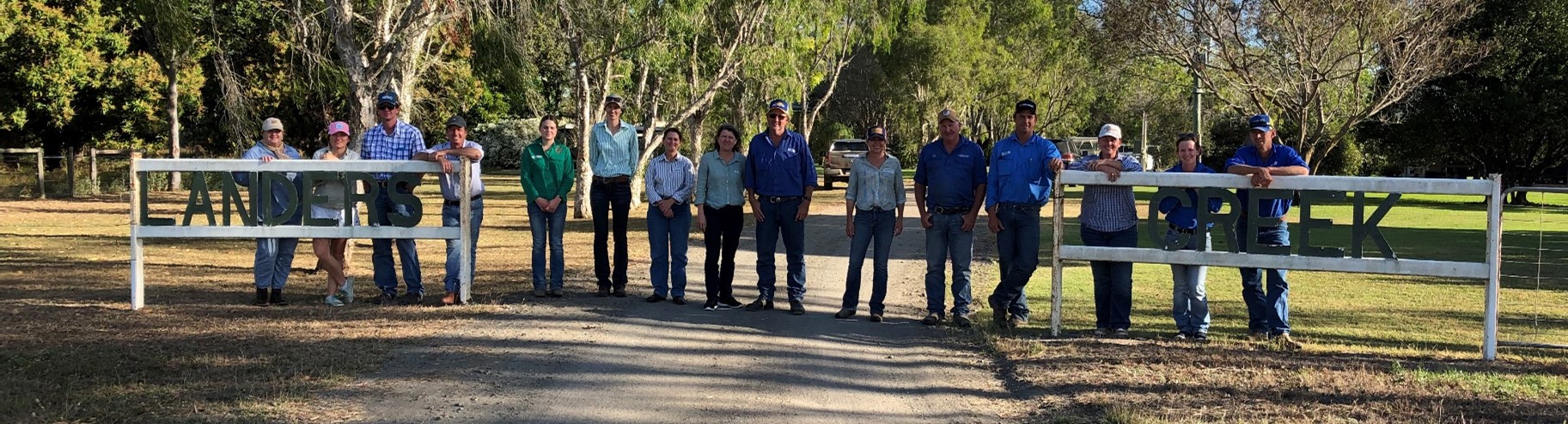
The Burdekin 7 project was led by a group of producers who demonstrated that digital technology could provide valuable insights into both herd performance and pasture condition. At the same time, the trials highlighted that technology must fit within existing business systems and deliver clear benefits to justify the investment.
Just as importantly, the project showed the value of collaborative learning among producers. Through shared experiences and practical trials, the Burdekin 7 group helped answer how data driven decision-making can support more productive, profitable and sustainable grazing businesses across northern Australia.
After 3 years of working together in the MLA NB2 pilot program, the group continued to explore ways to improve productivity and profitability through the Burdekin 7 project, supported by Farmer Peer-to-Peer funding through the Queensland Government’s Integrated Engagement and Capacity project.
To track progress and focus their efforts, they used Key Performance Indicators (KPIs) to pinpoint improvement areas, guide technology selection, and measure outcomes during the trials. The key KPIs were:
- mortality rate
- Fertility rate
- ground cover
- total standing dry matter (kg/ha)
- kilograms of beef produced per adult equivalent (AE).
| Technology trialled | Businesses utilised |
|---|---|
| Gallagher APS | 7 |
| BlackBox Co | 6 |
| CIBO Labs | 6 |
| Long Paddock | 4 |
| AgriWebb | 2 |
| Bush Agribusiness Analyser | 2 |
| Mobble | 1 |
| Excel | 7 |
Where do I even start?
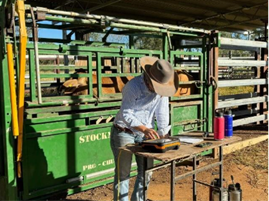 A shared focus across the Burdekin 7 group was improving herd performance. They decided that the first step was to have records on each animal. Some producers were relatively new to herd recording; however, all began by NLIS tagging each animal and scanning them through the yards in order to develop a data base. This became the foundation to measure and manage fertility, mortality, and kilograms of beef per Adult Equivalent (AE).
Across the group, producers emphasized that collecting accurate data was only valuable if it informed action. Many reported noticeable improvements in reproduction and feed utilisation due to having more accurate figures to base decisions on rather than only going with gut feel.
Identifying underperforming animals was consistently reported as a key indicator for informed culling decisions. At Cranbourne Station, the Coleman family used Gallagher APS to improve re-breed rates and calving intervals by tracking which cows calved on time.
“The main benefits were measuring calving intervals, not just relying on wet/dry. Ensuring cows that are PTIC turn up with a calf at the right time.” — Coleman Family, Cranbourne Station
The Searle family at Jerona Station used NLIS, visual tagging, Gallagher APS, and BlackBox to track fertility and mortality and make management decisions around this as well as evaluate the cost of unproductive cows.
“[It] allowed our fertility rate to be identified annually and among different ages/classes, we were able to get an actual figure on mortality rate in each paddock, we are able to see the cost of producing a calf and the financial cost of carrying an empty cow.” — Searle Family, Jerona Station
Is more actually merrier?
Producers noted that in certain circumstances combining multiple tools led to double handling with limited added value. The Searles found that using Gallagher and BlackBox together created some overlap, while the Healing family at Warrawee Station observed that using Mobble, Gallagher and Excel together created extra steps without significant benefits. Every tool is practical but only when it can be used for its specific purpose. The most effective tools are those that provide actionable insights, integrate with existing systems, and reduce guesswork. Success depends on selecting technologies that fit the business, rather than accumulating platforms.
“Data needs to be useful and relevant to your situation, to help with decision making processes, not for the sake of just having the information if you’re not going to do anything with it.” — Healing Family, Warrawee Station
In short, the Burdekin 7 project demonstrated that practical, targeted data collection can improve herd efficiency, but only when technology is purposeful, relevant, and integrated into everyday management.
Can I rely on tech in my decision making?
The Burdekin 7 group decided they wanted to be able to quantify their pasture and land condition to better match their stocking rates to available feed without impacting the longevity of their country. This would lead to better utilisation and observations of areas that were being over and under grazed. Therefore, the group decided on two key metrics they wanted to focus on: ground cover and total standing dry matter.
At Landers Creek, the Tudehope family integrated CIBO Labs into their livestock management platform via AgriWebb, allowing both cattle numbers and feed availability to be viewed together at the paddock scale.
“Everything is together, cattle numbers and pasture levels for each paddock, and it’s accessible to everyone, which makes it easier to see feed on offer and stocking rates.” — Tudehope Family, Landers Creek
Families like the Marks and Tudehopes found that whole-property maps highlighted paddocks with declining ground cover and areas where grazing pressure needed adjustment.
Producers found that the added data provided by tools such as CIBO Labs and Long Paddock did make them more confident when adjusting stocking rates or planning around when to shift or sell cattle. However, producers emphasised that satellite-based models still require ground truthing (physically measuring pasture biomass in the paddock) to verify accuracy and understand pasture trends across large areas.
Is it simple to use?
In certain areas with high tree cover or diverse vegetation interpreting the data became more challenging. The Johnson family at Trafalgar Station worked closely with Long Paddock developers to provide feedback and improve the tool’s usability.
“There’s a lot of information to interpret and it can take time to understand how the numbers relate to what you see in the paddock.” — Johnson Family, Trafalgar Station
Producers noted that while technology can deliver powerful insights, it works best when combined with traditional on-ground measurements. Satellite models and digital platforms give a broad view of trends, but hands-on verification ensures accuracy and builds confidence in decision-making.
Despite some teething issues, all families reported long-term benefits from digital pasture monitoring. The tools provided a clearer picture of pasture trends, supported more informed grazing decisions, and improved confidence in aligning stocking rates with available feed.
The value of producer groups
Despite everyone being at slightly different stages of the tech adoption journey at the beginning of their collaboration there was an overwhelming consensus that peer to peer learning could not be understated, that the greatest benefit producers gained from the experience was the opportunity to collaborate with others.
Beyond differences in land types and rainfall, the participants of Burdekin 7 group ran different cattle, targeted different markets, approached management differently and came to the group with different opinions and experiences. This diversity has created valuable opportunities to share ideas and build on one another’s knowledge.
“The whole group was very diverse when formed – different markets, cattle and enterprise mix – coming in fresh was an advantage and [we] have built up a lot of trust and want to see each other succeed and want to share and collaborate as much as possible.” – Marks family, Winvic Station
Participants noted that attending training sessions and workshops together often led to more productive discussions and deeper understanding.
“[You] get a lot more out of training when attending with the group, [When you’re] familiar and comfortable with each other [you] get so much more out of any events, [just] feeding off each other — Tudehope family, Landers Creek
Tips, tricks and advice
-
Start with research
“Do extensive research before outlaying a large amount of money for subscriptions. Undertake free trials, if possible, to get a feel for the program.” – Healing Family
“Sometimes simpler programs like Excel can be just as effective and less expensive. It’s easy to print off data and provide it to other members of the business without them needing to log in.” – Healing Family
“Chat with sales reps in more depth to ensure the program will do what you want it to do.” – Healing Family
“Seek out and talk to people using the tech you are thinking about using.” – Coleman Family
-
Don’t skip the setup
“Make the time at the start to sit down with the specialists of the tech you choose and go through what you want to get out of it and how it works. It saves a lot of time and double handling of data.” – Johnson Family
“Spending a day at home going through your own data was far more beneficial than trying to learn what the program can do at a field day.” – Johnson Family
“Knowing exactly what you want to measure and having templates and formats already in place makes a big difference.” – Johnson Family
“Have clear objectives and know what you want to get out of the data before you start, then work backwards to determine what information you need.” – Johnson Family
“Making sure data is entered the same between all the years is important for accurate and easy filtering and analysis.” – Searle Family
-
Keep technology practical
“Data needs to be useful and relevant to your situation, to help with decision making processes, not for the sake of just having the information if you’re not going to do anything with it. – Healing Family
“You need to know what you are going to do with the information that you get. And don’t be afraid to trial something and to stop using it if it isn’t providing value” – Tudehope Family
“Start with basic recording that is most relevant to your production system…. We used condition scoring at the start of the trial [as it] was a better reflection of what was happening with the cows and saved us the initial cost of purchasing weigh bars.” – Coleman Family
-
Learn from your peers
“Do it! It’s a great way to connect with people. You all speak the same language and it’s an opportunity to see how other people do things.” – Johnson family
“Someone in the group may have already started and can give you advice when you’re in the cattle yards and can’t get something to work. Or you might both be starting out and bouncing ideas off each other.” – Searle Family
“It is great to know we have a trusted group with no judgement or hierarchy.” – Searle Family
For producers new to technology, their advice is to take it step by step.
“Start with something simple and then move onto more technical programs or data analysis as you get more confident.” – Healing Family
Finally, the overwhelming sentiment was…
“Just do it! don’t be afraid to ask for help.” – Coleman Family
The Farmer Peer-to-Peer Group Support funding is part of the Integrated Engagement and Capacity Building project, funded through the Queensland Government’s Queensland Reef Water Quality Program and delivered by the Department Primary Industries (DPI).
Want to download a print friendly version of this article? Producer insights into measuring what matters – Burdekin 7