Automated cattle weighing: what are your options?
Key takeaways
- Regular recording of liveweight data supports better decisions around weaning, supplementation, sale timing and animal health
- Traditional crush scales are the gold standard for accuracy, but automated systems can reduce labour, handling and stress
- Walk-over weighing suits operations where cattle regularly pass a fixed point, such as a water source
- Smart feeding or supplement weighing systems can combine intake monitoring with liveweight data
- Image-based weighing offers flexible point-and-shoot weighing without permanent infrastructure or animal training.
Why liveweight matters
Liveweight is one of the most useful production measures in a beef business. It supports decisions around when to wean, when to supplement, when cattle are ready to sell, and how well pasture and feeding programs are performing.
Traditionally, weighing means bringing cattle into the yards and running them over crush scales. While accurate, this takes time, labour and planning. It can also add stress to cattle, particularly when animals are a long distance from the yards, or when handling pregnant cows, cows with calves or highly excitable weaners.
In northern Australia, cattle may only pass through the yards a few times each year. As a result, producers often have limited liveweight information available when making decisions around supplementation, paddock moves, sale timing or drought management.
Automated weighing systems are helping bridge that gap by providing more frequent liveweight data with less labour and handling.
There are several different technologies available, each suited to different production systems. Below is a summary of some of the main options.
Walk-over weighing | Smart feeding scales / in-paddock weighing | Image-based automated cattle weighing system
Walk-over weighing
What is it?
Remote, in-paddock cattle weighing using a platform installed at a controlled access point, usually near water.
Cattle are weighed automatically each time they walk across the platform, allowing producers to monitor individual animals and mob performance without mustering or yarding.
Best suited to properties where cattle regularly visit a single water point.
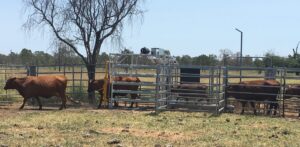
Walk over weighing technology in action at Belmont Research Station, Etna Creek QLD
How does it work?
The system comprises a weigh platform, in-built RFID reader and data processor, powered by a solar panel. As cattle walk across the platform, their NLIS tag and liveweight are recorded automatically and uploaded to an online dashboard.
A fence is installed around a watering point or another attractant such as supplement, which cattle can only access by walking over the weighing platform.
The watering area needs to be large enough for cattle to drink comfortably, but not so large that animals camp there and avoid repeat crossings.
Some systems allow cattle to exit the same way they entered, while others use an exit spear trap to improve flow.
Cattle require training to use the system. Some animals may initially rush over the platform or avoid it altogether, which reduces the chance of collecting an accurate weight. The training period is especially important when the platform is the only access to water to avoid any risk to animal welfare.
System performance depends heavily on good site selection, cattle flow and cattle regularly using the watering point where the system is installed.
Why should I use one?
- Monitor individual animal performance without mustering
- Reduce labour associated with repeated yard weighing
- Identify health or performance issues earlier
- Record reproduction information. Repeated weight records, EID data and, where fitted, camera systems can help identify calving dates, establish cow-calf pairs and estimate conception dates.
- Some designs may also incorporate auto-drafting
Commercial options
Smart feeding scales / in-paddock weighing
What is it?
A portable in-paddock weighing system that automatically records liveweight when cattle visit a supplement feeder or attractant point.
Systems such as Optiweigh use a single-bay weighing crate with in-built RFID reader and data processor. Cattle voluntarily enter the unit, are weighed, and leave without needing yarding or handling.
Regular liveweight data can be collected in real time while monitoring how cattle are responding to pasture conditions, supplementation and grazing management.
Best suited to producers using supplements or attractants and wanting to compare performance between paddocks or management groups.
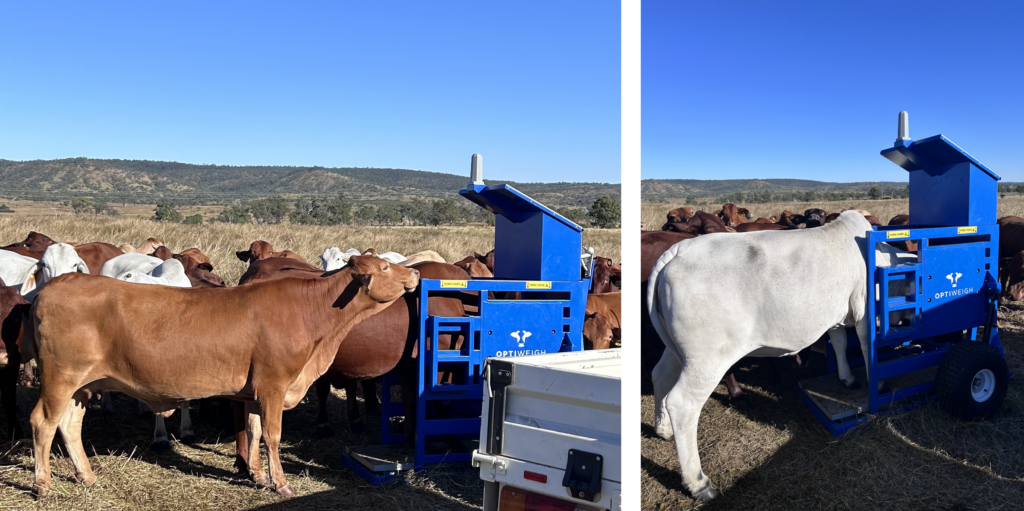
Cattle using an Optiweigh unit at Brian Pastures, Gayndah QLD
How does it work?
The portable unit contains a feed attractant, such as a molasses or lick block, to encourage cattle to enter the weighing crate voluntarily. As the animal accesses the supplement, its NLIS tag is scanned and it’s liveweight estimated from the weight recorded on the platform. As only the animal’s front feet are on the weighing platform, algorithms are used to predict its total liveweight, reported to be ~93% accuracy compared to static scales.
Weight records are transmitted via the unit’s built-in satellite communication system to an online dashboard that can be viewed on a computer or mobile device. Individual animal weights, mob average liveweight and average daily gain can be monitored over time.
The unit is solar powered and can be towed between paddocks, making it suitable for comparing performance across different grazing areas or management groups.
Cattle need training to learn to enter the weighing crate calmly and regularly access the supplement or attractant. Some cattle may be hesitant initially, particularly if they are unfamiliar with confined spaces or flighty around novel infrastructure. Positioning the unit where cattle already visit, such as near supplement, and providing a consistent attractant can improve use.
Why should I use one?
- Compare cattle performance between paddocks or grazing systems
- Determine the effectiveness of supplementation programs
- Identify shy feeders and poor performers
- Track progress towards market specifications
- Reduce labour and stress associated with repeated yard weighing
- Monitor animal health and identify issues earlier.
Commercial options
Image-based automated cattle weighing system
What is it?
Using a smartphone camera to estimate cattle liveweight without bringing animals through fixed weigh scales.
Rather than mustering cattle through yards and onto crush scales, producers can use a phone to scan an animal in the paddock or yards and receive a liveweight estimate within seconds. This provides a lower-stress alternative for monitoring growth, sale readiness and mob performance.
One example is Scanabull, a New Zealand-developed system using an iPhone Pro and LiDAR-based 3D imaging.
Best suited to producers wanting a portable, low-infrastructure option for liveweight monitoring.
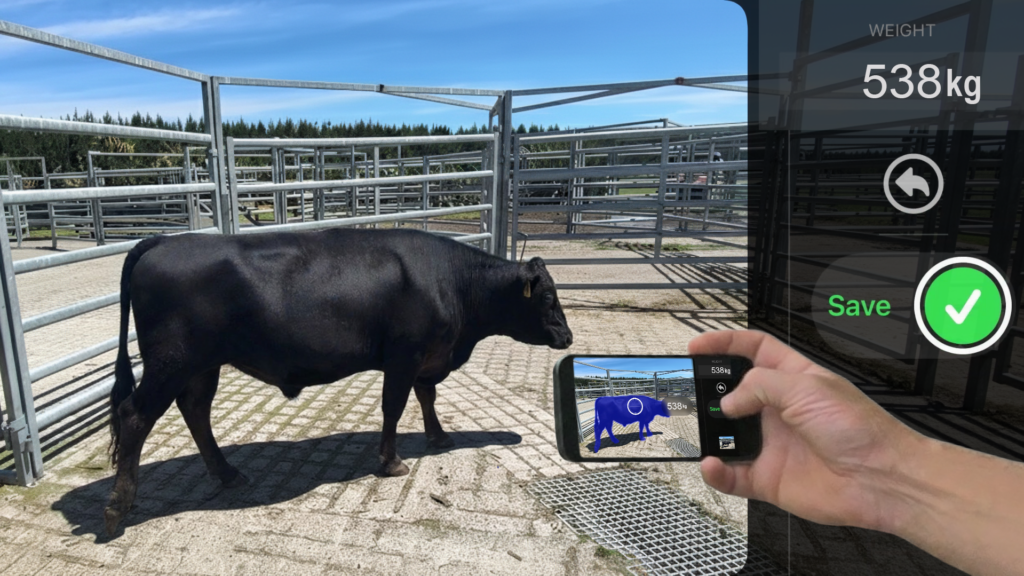
Using Scanabull’s iPhone app to estimate cattle liveweight. Image supplied by Scanabull.
How does it work?
The system uses the LiDAR (Light Detection and Ranging) sensor on an iPhone Pro to capture 3D image of the animal. Artificial intelligence is then used to estimate liveweight from the image.
Processing occurs on the phone itself, so mobile coverage or internet access is not required while weighing.
The user simply scans the animal using the phone’s camera. Once the animal is fully in view and the weight stabilises, the user can save the weight along with a photo of the animal, the date and time as well as the mob average and weight distribution data. Reports suggest individual animal accuracy is above 93% compared to conventional scales.
The system currently requires an iPhone Pro as standard iPhones do not have the required LiDAR scanner.
Why should I use one?
- Weigh cattle without infrastructure or animal training
- Monitor liveweight more frequently between yard weigh-ins
- Keep a visual record of cattle condition alongside liveweight data
- Use in paddocks, laneways or yards.
Commercial options
- Scanabull (expected commercial release in Australia late 2026).
Which system suits my operation?
No single system is best for every business. The most suitable option depends on your infrastructure, cattle flow, labour availability and how you intend to use the weight data.
| Feature | Walk-over weighing (WoW) | Smart feeding / in-paddock weighing | Image-based weighing |
|---|---|---|---|
| Automation | Fully automated | Fully automated | Manual |
| Individual animal tracking | Yes | Yes | Not currently |
| Infrastructure required | High | Moderate | Low |
| Internet | Yes Required for syncing and reporting Not for weighing | No In-built satellite communication | Yes Required for syncing data Not for weighing |
| Portability | Low | High | Very high |
| Animal training | Yes | Yes | No |
| Best suited to | Fixed water points | Supplement feeding systems | Flexible paddock or yard use |
Practical tips for producers
- Start with the management problem, not the technology
- Consider whether you need exact sale weights or regular monitoring trends
- Assess cattle flow and infrastructure before choosing a system
- Training cattle to use walk-over weighing and Optiweigh is critical to achieve consistent and accurate data
- Consider internet connectivity, power supply and ongoing maintenance requirements
- Check whether systems integrate with NLIS, EID readers and existing herd management software
- Consider where the return on investment will come from — labour savings, improved sale timing, better animal performance or reduced animal handling.
Technology works best when it solves an existing management issue, and the data is used to help make better, informed decisions.
More information
Read how Walk Over Weigh and other innovative technologies are supporting management decisions at Richmond →
Learn how Echo Hills uses walk over weighing to support management decisions →
Find out why Optiweigh has been a game changer for Kurt Mayne’s backgrounding business →