NQ producer spotlight: planting legumes into existing pastures – Patrick’s insights
Key learnings
Patrick credits the progress on his property to the combined implementation of several management changes, rather than relying on any single practice. By integrating rotational grazing, legume establishment in existing pastures, and reinvestment in soil fertility, he has created a system where each practice supports and enhances the others. He also credits ongoing guidance from DPI extension officer Bernie English, whose practical advice helped shape grazing, fertility and pasture decisions over time.
Patrick views pasture improvement as a gradual process rather than a one-off intervention.
“You’re never going to fix it in one go. You pick up five or ten percent at a time.”
“You just try to make it as good as you can and keep improving it.”
Background
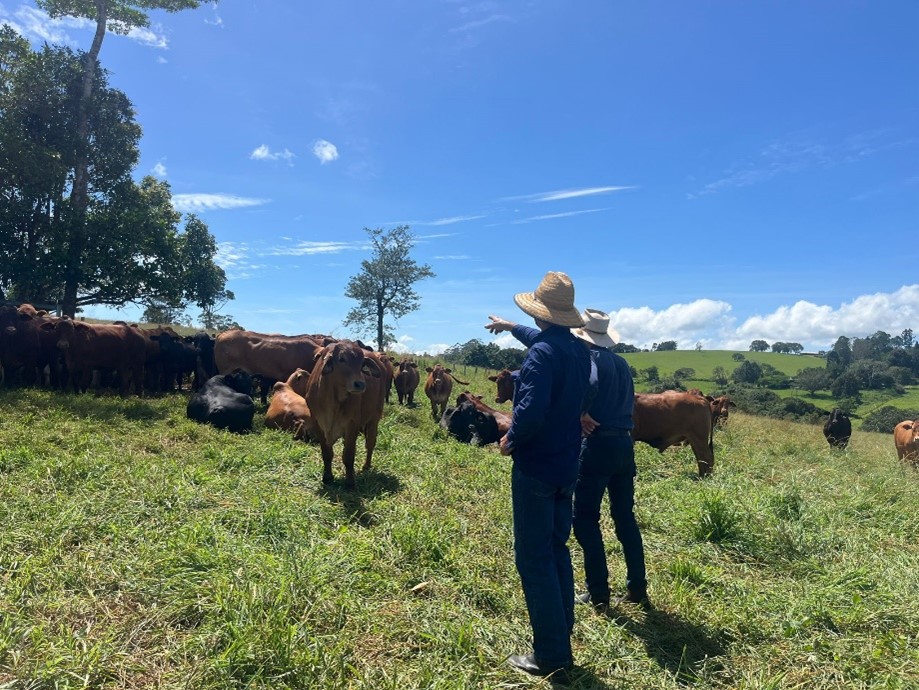
Patrick Donaghy operates a 250-head beef finishing enterprise on roughly 400 acres of basalt soils in the Atherton Tablelands, North Queensland. The property is situated between two extinct volcanic crater lakes on an elevated plateau in the Great Dividing Range, approximately 750 metres above sea level. With an average annual rainfall of around 1,380 mm and nutrient-rich soils that promote vigorous pasture growth during the wet season, managing pasture balance and maintaining groundcover can be challenging due to factors such as intense rainfall events, seasonal insect activity, and strong grass – legume competition. Historically, the property has been managed using set stocking, with cattle grazing continuously across paddocks throughout most of the year. This has resulted in the animals repeatedly following the same paths between camps, water sources, and shade. Grazing pressure has become concentrated in certain areas, leaving others underutilised. Over time, this practice has led to the formation of tracks, bare patches on hills, increased weed growth, and a decline in pasture quality.
“They kept eating the same areas and walking the same tracks. Some hills were just dirt and weeds.”
Pasture fertility had also declined, with fertiliser not applied for around 17 years due to financial limitations.
“Dad had no money at the time, so we never fertilised for about 17 years.”
Legumes were present only in scattered patches and contributed little to pasture production or nitrogen supply. Patrick, alongside his father John and with input from DPI Principal Extension Officer Bernie English, trialled legumes on the property for many years. Early attempts confirmed legumes could grow in the environment but showed that successful establishment across the farm required changes to grazing management, soil disturbance and fertility.
Bernie now describes Patrick’s property as having some of the best legumes on the Tablelands.
Practice change
Pasture improvement has resulted from three practical changes applied together over time:
- adoption of rotational grazing
- establishment of legumes
- reinvestment in fertiliser and trace elements.
Rotational grazing
Rotational grazing was introduced progressively with guidance from Bernie English. Patrick had been sceptical early on after seeing rotation done poorly elsewhere, but now seeing it implemented correctly he has changed his view.
“I’d seen someone rotating badly and it put me off. But once you see it done properly, the change was the best thing we ever did.”
Moving cattle between paddocks reduced repeated grazing of preferred species, spread utilisation more evenly and allowed pasture recovery. Groundcover improved and previously bare areas has also begun to recover. Patrick also observed a clear change in cattle behaviour.
“Cattle that rotate are easier to handle. They’re used to being moved.”
Rotation has also proved critical for legumes. Earlier establishment attempts under set stocking were slow and patchy. With controlled grazing periods and rest, seedlings have been able to survive and persist.
Stocking rate remains an important constraint. The property typically carries around 240–250 head on 400 acres, which Patrick recognises is close to the upper limit for maintaining pasture condition.
Legume establishment into existing pasture
In addition to implementing rotational grazing, Patrick has prioritised introducing legumes into his existing Setaria-dominant pastures rather than completely renovating the paddocks. His goal has been to create enough space within the pasture for legumes to establish, while managing grazing pressure and grass competition to ensure their persistence.
Initially, Patrick used a ripper fitted with a coulter wheel to create rip lines directly through standing pasture. He then spread seed by hand behind the tractor, allowing it to fall into the disturbed soil.
“We used a ripper, and I ran behind it spreading seed. The rip line gives the taproot somewhere to go,” he explains.
At first, paddocks were neither slashed nor heavily grazed before ripping. After sowing, the paddocks were rested to allow the legumes to establish. While this method did result in legume establishment, the process was often slow and uneven due to strong competition from the grass.
Through trial and error, Patrick discovered that reducing grass competition before sowing is essential for successful legume establishment. He now ensures paddocks are heavily grazed or slashed before ripping to open up the pasture and reduce competition for light and moisture. This adjustment has significantly improved the speed and uniformity of establishment.
“Everyone who stops the legume getting overshadowed ends up with a better paddock,” Patrick notes.
After sowing, he rests the paddocks during the early establishment phase and carefully manages grass growth through mowing or well-timed grazing to prevent the legumes from being overshadowed.
“You’ve got to keep that grass down… you will have to mow it,” he advises.
Patrick has observed that legumes establish most successfully in areas where the pasture is already weakened or disturbed, while dense, vigorous grass poses the greatest challenge.
“If you’ve got really good grass like that, it’s hard to get it established,” he says.
“Where you’ve got a bit of a weak pasture, that’s a nice place to start.”
Soil fertility
Reinvestment in soil fertility has been the third major change underpinning pasture and legume improvement on the Donaghy property. Fertiliser use had been very limited for many years, and pasture fertility had declined as nutrients were removed through grazing and leaching.
Patrick now uses soil sampling to assess fertility status and guide fertiliser decisions. Earlier fertiliser programs at the property focused mainly on phosphorus to support legume growth and persistence.
“We were told phosphorus was money in the bank.”
Later soil test results showed phosphorus levels were already high in some paddocks. Fertiliser programs have now been adjusted to balance nutrient replacement, particularly nitrogen and potassium, which Patrick recognised were more easily lost in the high rainfall Wet Tropics environment.
“Potassium and nitrogen wash through here.”
Patrick believes to reinvest in fertiliser across the property rather than draw additional income from the business.
“We could have given ourselves a pay rise, but we fertilised the whole block instead.”
Trace elements have also been addressed. Sodium molybdate has been applied aerially every 3 to 4 years to support legume nodulation and nitrogen fixation.
Improved fertility has supported both pasture vigour and legume persistence, allowing legumes to contribute nitrogen and improving overall pasture productivity. Fertility is now managed proactively through soil testing and regular fertiliser application.
The improvements in pasture management have also positively impacted livestock performance. Patrick’s cattle consistently achieve high rankings in local carcase competitions, demonstrating the tangible benefits of enhanced pasture management and soil fertility on production outcomes.
Written by Shannon Byrnes from Mareeba DPI, as part of the Queensland Pasture Resilience Program which is a partnership between the Department of Primary Industries, Meat & Livestock Australia and the Australian Government through the MLA Donor Company.