Unlocking the potential of nitrogen use efficiency in northern cattle systems
Summary
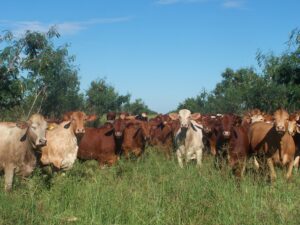 A new tail hair test can measure nitrogen use efficiency (NUE), showing how well individual cattle convert dietary protein into growth and production.
- Cattle with higher NUE were found to wean heavier calves and have lower rates of calf loss.
- NUE varies between animals. Those with higher NUE had better average daily gain (ADG) under low-protein diets and urea supplementation than those with lower NUE.
- NUE is moderately to highly heritable, creating opportunities to select and breed more efficient cattle.
- Improving NUE has potential to increase productivity and profitability while reducing nitrogen losses to the environment.
A new tool for efficient herd management
Researchers have identified a new way to measure how individual cattle use dietary nitrogen, with significant implications for growth, reproduction and profitability in the northern Australian beef industry.
Using a novel stable isotope test on tail hair, scientists can now identify animals that efficiently retain nitrogen for critical functions like growth, muscle development and milk production. The test can also estimate nitrogen lost in urine, which represents wasted feed protein and reduced efficiency. This is particularly important in extensive grazing systems where dietary protein fluctuates widely based on seasonal conditions. Ideally, your stock would be using this critical element as effectively as possible.
The research, led by Associate Professor Luis Prada e Silva and his team at the Queensland Alliance for Agriculture and Food Innovation (QAAFI), is the result of 7 years of work. It integrates large-scale cattle datasets, a systematic literature review and meta-analysis across beef and dairy studies, and detailed phenotyping from the Calf Alive project involving more than 4,500 cows with reproductive records.
Tracing nitrogen through isotopes
At the heart of this breakthrough is the development of stable nitrogen isotopes (N15 and N14) measured in tail hair. This allows researchers to differentiate between nitrogen retained in the body (for tissue and milk production) and nitrogen excreted in urine.
Researchers found that cattle with greater nitrogen use efficiency (NUE) — the ability to convert nitrogen in feed into productive outcomes like weight gain — had lower concentrations of N15 in their tail hair. Conversely, animals with lower NUE had higher N15 levels, correlating with greater nitrogen excretion in urine and reduced feed conversion efficiency.
Variations between individuals and breeds
An important finding is the wide variation in NUE between individual animals, even within the same breed and management group. Not all animals respond equally to changes in dietary protein — when high quality, high-protein diets were replaced with low quality, low-protein diets, high-NUE animals maintained superior performance compared to their low-NUE counterparts. In one trial, a cohort of steers with high NUE gained up to 40% more weight than less efficient animals fed the same diet.
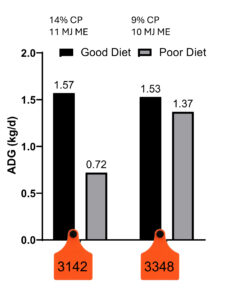
Figure 1. Comparison of two steers with contrasting nitrogen use efficiency (NUE). When fed a high-quality, high-protein diet, both steers achieve similar average daily gain (ADG). However, when diet quality and protein decline, the high-NUE steer (ID 3348) conserves nitrogen more effectively and maintains growth, whereas the low-NUE steer (ID 3142) shows a marked reduction in performance, gaining approximately half as much weight.
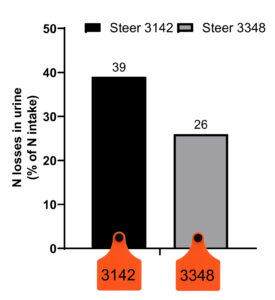
Figure 2. Differences in growth are explained by urinary nitrogen excretion, which is greater in the low-NUE steer (black bar, ID 3142) than in the high-NUE steer (grey bar, ID 3348).
Economic and reproductive impacts
Using data from the Calf Alive project, researchers showed that higher NUE linked directly to improved growth and reproductive performance. Cattle with lower N15 concentrations in tail hair weaned heavier calves and showed a marked reduction in calf loss, producing greater kilograms of liveweight per breeder.
Each 1% decrease in N15 levels in tail hair decreased the odds of calf loss by 23%. This improvement is attributed to better feed conversion, enhanced maternal body condition and improved colostrum and milk quality. This is a critical finding in the effort to identify the underlying causes of calf loss in northern Australia.
Economic modelling indicated that on a representative 2,500-breeder enterprise, selecting animals with superior NUE could deliver approximately $63,000 in additional gross margin, as a result of increased calf survival and weaning weights in heifers and first lactating cows alone.
Implications for feed supplementation
Supplementation trials showed that responses to urea supplements varied markedly between individuals depending on their NUE. In a study involving 24 Brahman steers, high-NUE animals responded more effectively to urea supplements, resulting in over 200 grams/day higher liveweight gain than their low-NUE counterparts. Additionally, low-NUE animals excreted a greater proportion of supplemented nitrogen in urine, reducing the return on investment in supplementation.
These findings suggest that genotype-specific responses to supplementation could be an important consideration in extensive systems, particularly where supplement costs are significant.
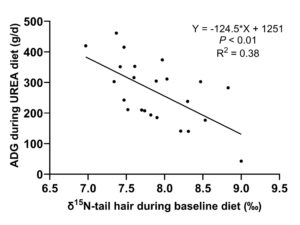
Figure 3. There was a linear relationship between steers weight gain when fed urea supplements and nitrogen use efficiency as determined by nitrogen isotopes measured from tail hair.
Genetic potential and future applications
Scientists found NUE to be moderately to highly heritable, suggesting a promising role in breeding objectives. Current research is focused on identifying genomic markers for the development of genomic breeding values (GBVs), allowing producers to selectively breed cattle that more efficiently convert dietary protein into production.
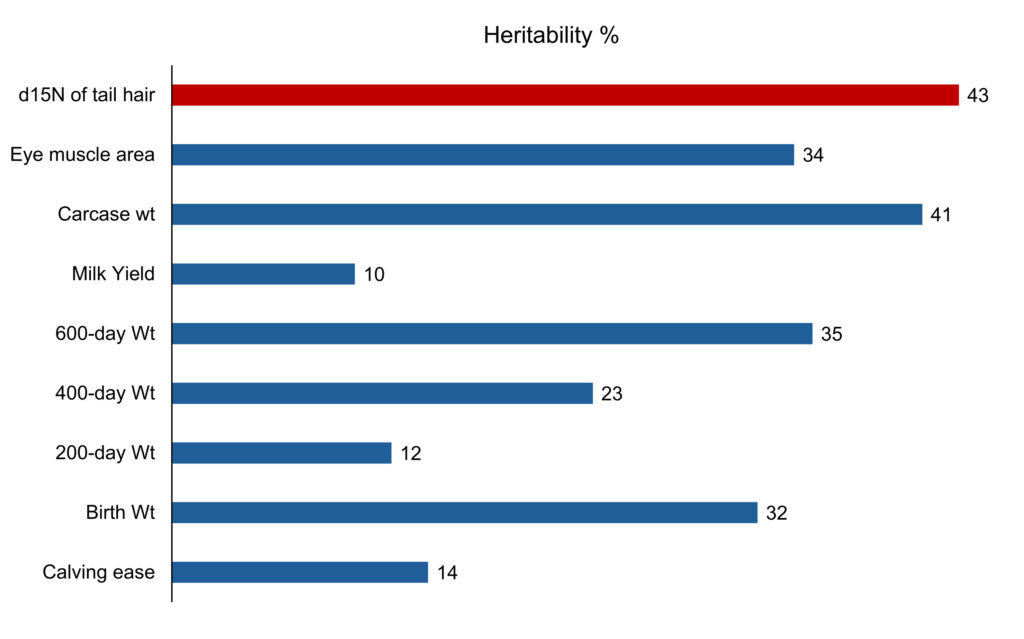
Figure 4. A comparison of the percent heritability of known genetic traits in beef cattle compared with the heritability of isotopic N15 in tail hair based on current studies.
Beyond productivity, improving NUE could also deliver environmental benefits, as lower nitrogen excretion correlates with reduced nutrient losses and potentially lower greenhouse gas emissions. While the relationship between nitrogen excretion and methane production is still under investigation, these findings highlight NUE as an opportunity to improve both farm productivity and environmental sustainability.
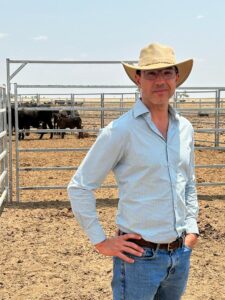 Associate Professor Luis Prada e Silva is using ground-breaking methods to measure how efficiently cattle use nitrogen. All photos and images provided by A/Prof Silva.
Rather watch than read?
Here is the recording of Associate Professor Luis Prada e Silva’s webinar (58 minutes) from QAAFI’s Science Seminar Series:
More information
Nutrient requirements of beef cattle →