Continuing the Challenge: AridGraze Brings Research and Producers Together
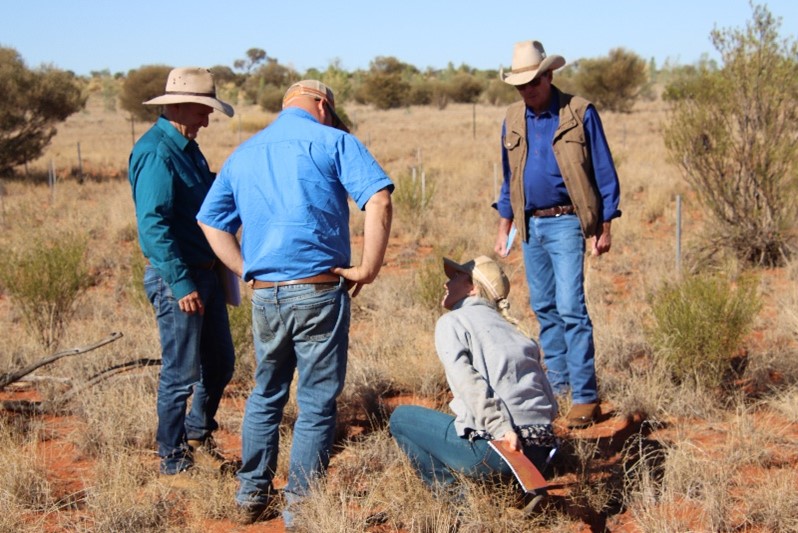
AridGraze is a new project designed specifically with and for cattle producers in the arid rangelands of Central Australia. The project will allow the research team, comprised of Department of Agriculture and Fisheries (DAF) Livestock Industries Development team and commercial cattle stations, to extend the successful commercial Paddock Challenge program for another 12 months and add a new Paddock Challenge on the Old Man Plains Research Station (OMP).
From 2022 – 2024, DAF worked with Central Australian stations to deliver the Rain Ready Rangelands project which allowed for the establishment of two “Paddock Challenges” on commercial stations. The Paddock Challenge concept compares business-as-usual managed paddocks with a ‘Challenge’ paddock where stocking decisions are based on research-derived long-term carrying capacity recommendations.
The initial two-year phase established trial paddocks, collected baseline data, and documented grazing strategies. You can read more about this initial work and our collaborators at Rain Ready Rangelands.
The AridGraze project will allow us to continue assessing longer-term trends and real-world outcomes on the 2 commercial stations with our collaborators, Shane and Alethea Nicolle at Mulga Park station and the Martin family at Mt Denison station.
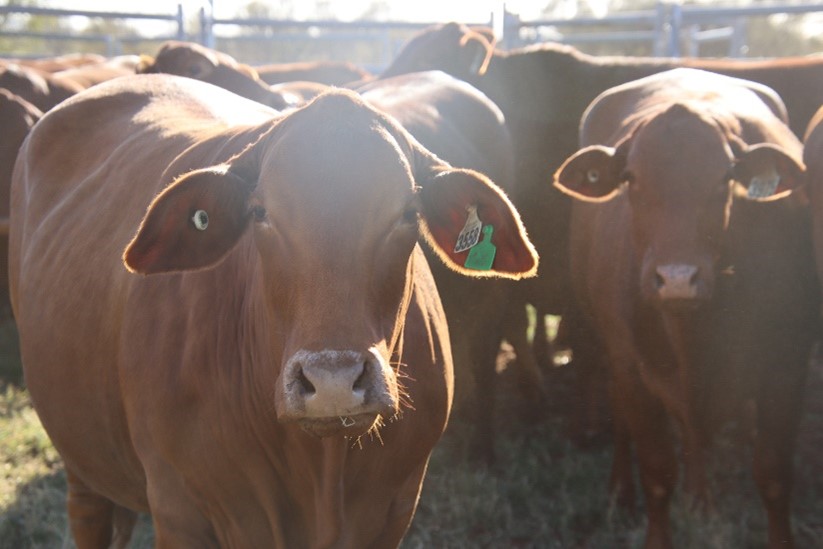
In 2026, AridGraze will initiate a third paddock challenge – an industry-managed paddock on DAF’s Old Man Plains Research Station (OMP) in Central Australia. For the new Paddock Challenge, we will have a group of Central Australian producers working with DAF researchers to advise on the stocking rate and grazing strategy in one of the paddocks on the research station. The group will consist of experienced producers and the next generation of young people who are making a start on their career.
The Producer Group
The producer group will meet on the research station in early 2026 where they will get to know the paddock, the cattle and OMP management practices. DAF will share the results of 15-year grazing trials conducted on OMP, the Rain Ready Rangeland Paddock Challenge results from commercial stations and look at how the research-derived carrying capacities are worked out. The Producer Group and researchers will then design the management strategy for the OMP Producer Paddock Challenge. Our goal is to have cattle in the Challenge by June 2026.
Being a part of a producer group has many advantages. Learning with and from your peers, in a small group environment is efficient and relevant, and giving back to your industry can be highly rewarding. It’s also hoped that there will be excellent catering and team dinners! We have big plans to continue collaborating with the Producer Groups well into the future.
What’s in it for industry?
Producers will have the opportunity to learn how researchers calculate carrying capacities for paddocks, and to observe the results from stocking paddocks at the calculated carrying capacities. While many producers are confident in working out their long-term carrying capacity, others are new to the region and don’t necessarily have decades of experience to tap into. Research results tested in commercial situations and in collaboration with industry representatives, provide practical benchmarks that help build trust and confidence in recommendations.
More information?
For more information on the AridGraze project contact Department of Agriculture and Fisheries (DAF) Senior Rangeland scientist and project leader Dr Robyn Cowley on 0419 829 493 or robyn.cowley@nt.gov.au.
For more information about the Producer Group, please contact DAF Rangeland Extension Officer Alison Kain on 08 8951 8101 or livestock.extension@nt.gov.au.